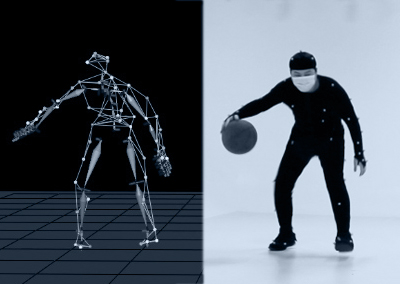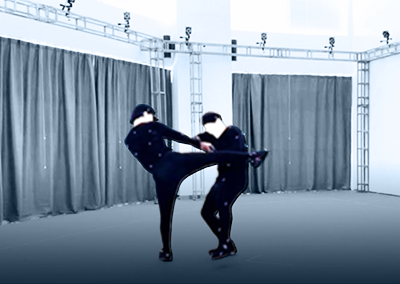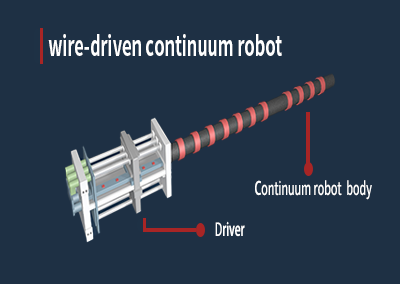
Researchers at China University of Geosciences (Wuhan) developed a three-segment, length-variable, earthworm-inspired continuum robot with a diameter of only 6 mm and compliant pneumatic actuation. A reflective marker attached to the robot endpoint was tracked by a NOKOV motion capture system, providing real-time 3D coordinates for performance evaluation and recording endpoint trajectories during writing tasks.
Case Overview
Item | Details |
Research team | Professor Qingxin Meng's team, China University of Geosciences (Wuhan) |
Paper | Length-Variable Bionic Continuum Robot With Millimeter-Scale Diameter and Compliant Driving Force |
Research object | Three-segment, length-variable, earthworm-inspired continuum robot |
Robot body | Three-segment backbone and transmission devices; 6 mm diameter |
Actuation | Soft drives based on pneumatic soft actuators (PSAs) |
NOKOV setup | A reflective marker attached to the robot endpoint |
Output data | Real-time 3D endpoint coordinates and writing trajectories |
Data use | Performance evaluation and endpoint-trajectory recording |
Key results | More than 70 mm length variation from 150 mm; 47% variation rate; maximum bending angle up to 125 degrees |
Publication | IEEE/CAA Journal of Automatica Sinica, Vol. 12, No. 4, pp. 655-667, April 2025; DOI: 10.1109/JAS.2024.125091 |
Research Background
Continuum robots for industrial inspection and minimally invasive medical research must be compact and capable of changing length in confined spaces.
Although rigid motors offer mature control methods, their driving forces can be abrupt. Combining miniaturization, a large length-variation range, and compliant actuation therefore remains a challenge, particularly where safe human interaction matters.
Research Method and Main Contributions
Inspired by earthworm deformation, the researchers designed a length-variable bionic continuum robot with a millimeter-scale diameter and compliant actuation.
1、 The 6 mm-diameter robot body consists of a three-segment backbone and transmission devices. Pneumatic soft actuators (PSAs) provide the compliant driving force.
2、 The team measured the pressure-displacement and pressure-force characteristics of the soft drives and used them to control the transmission devices.
3、 The backbone can change length and bend. From an initial length of 150 mm, it achieved more than 70 mm of length variation, while each segment can bend by more than 120 degrees.
4、 The robot completed digit-writing tasks and was also demonstrated in narrow-tube inspection and oral-monitoring scenarios.
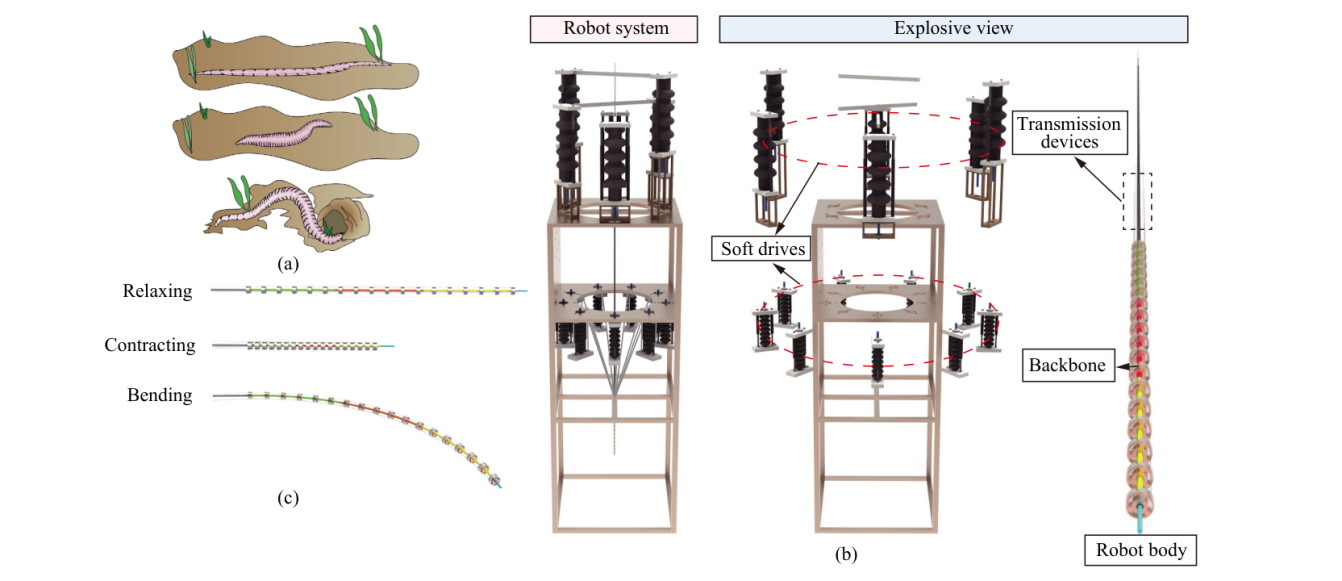
Figure 1. Bioinspired deformation and robot system. (a) Different deformations of the earthworm: relaxing, contracting and bending; (b) Length-variable bionic continuum robot with a millimeter-scale diameter and compliant driving force, composed of the robot body (including the backbone and transmission devices) and soft drives; (c) Different deformations of the backbone: relaxing, contracting and bending.
Robot System Design
The robot body combines a three-segment backbone with transmission devices in a diameter of 6 mm. The transmission system independently changes segment length and produces bending motion.
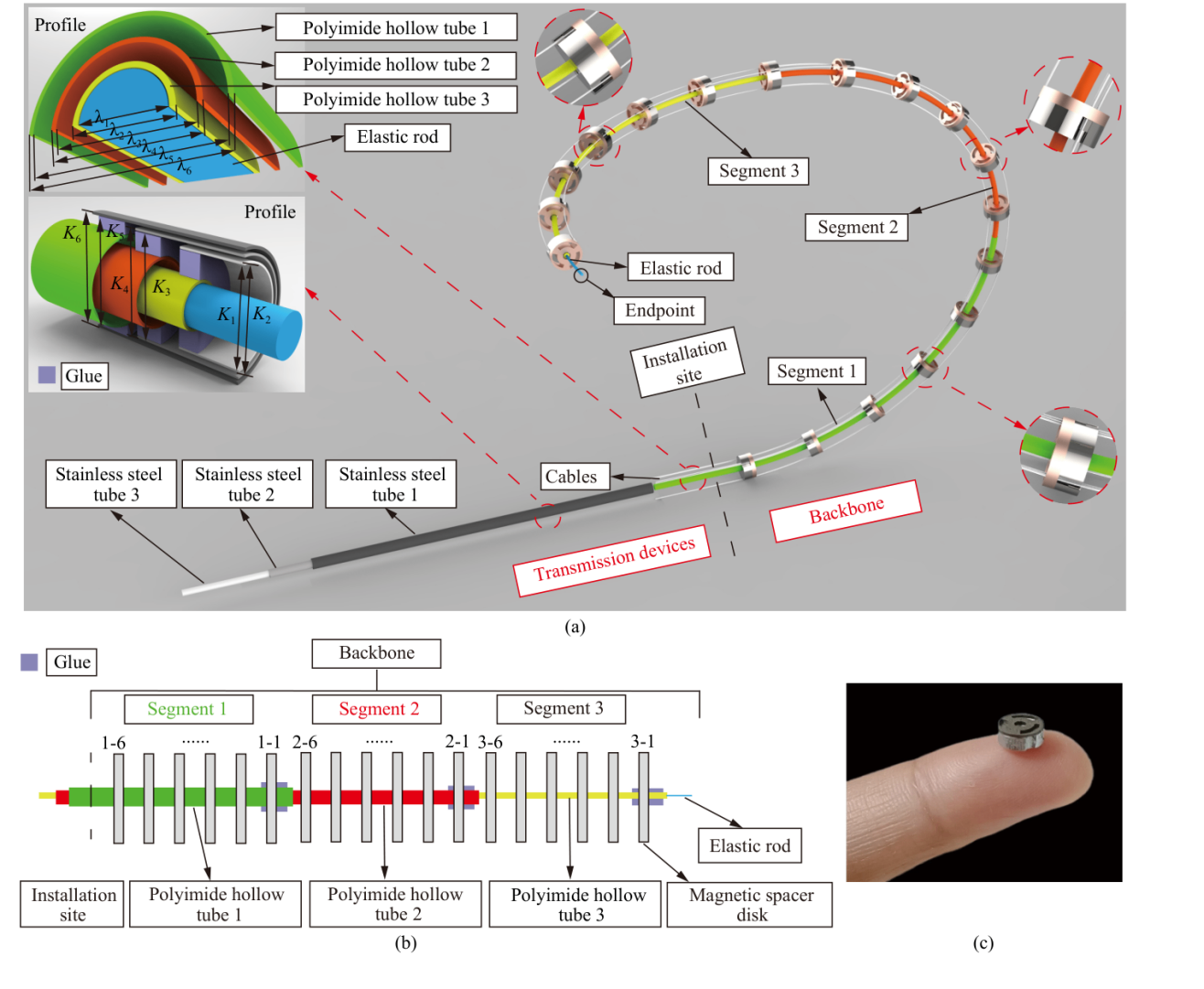
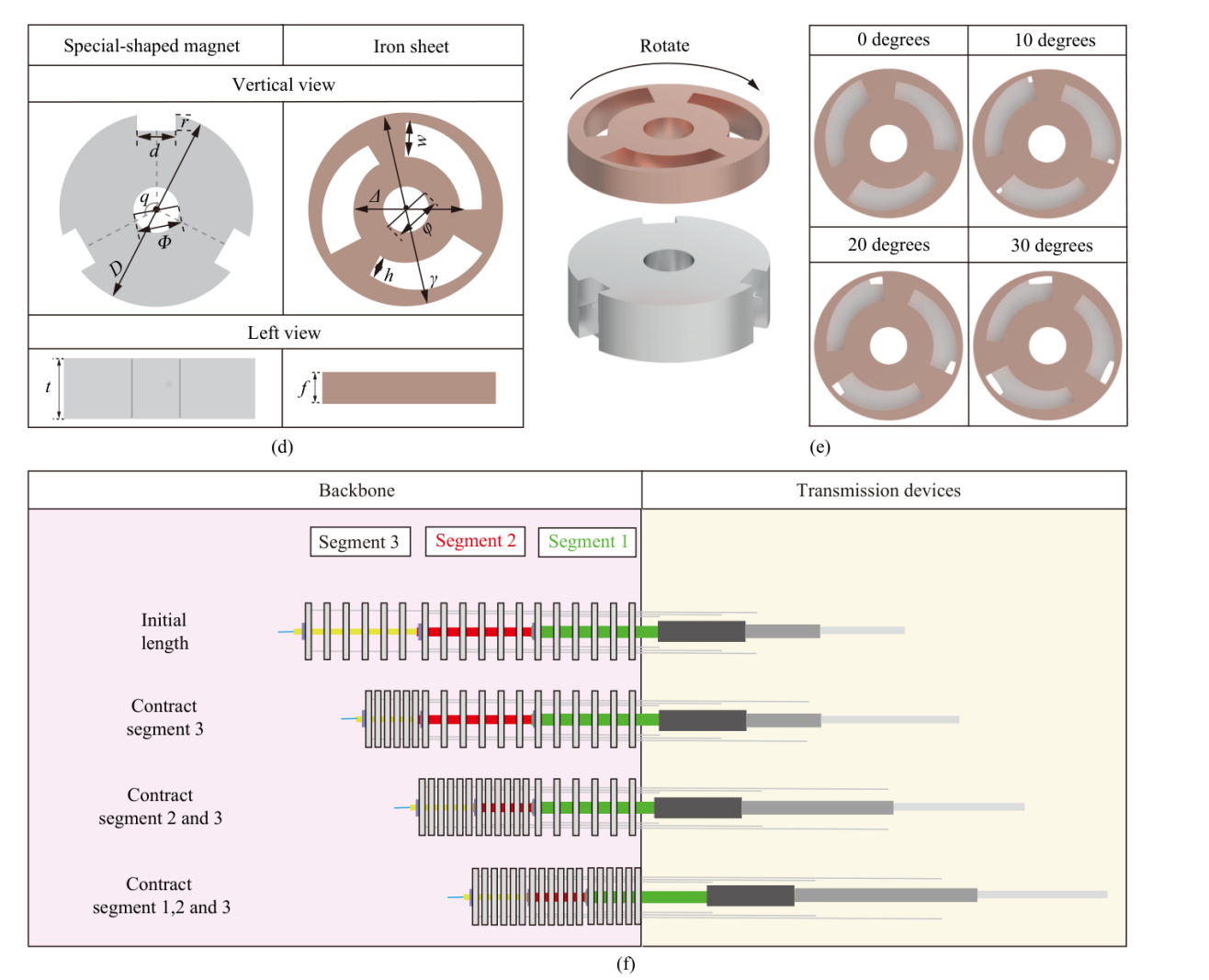
Figure 2. Robot body. (a) Robot body containing a three-segment backbone and transmission devices; (b) Simplified composition of the backbone; (c) Magnetic spacer disk (diameter: 6 mm), with an index finger as a reference; (d) Components of the magnetic spacer disk: a special-shaped magnet and an iron sheet; (e) Holes formed by the special-shaped magnet and iron sheet when the angle of the iron sheet is adjusted; (f) Different backbone lengths produced by adjusting the lengths of the three segments.
Soft Drives
Inspired by the soft muscles of earthworms, the researchers developed soft drives based on pneumatic soft actuators. Pressure-displacement and pressure-force measurements were used to characterize the actuators and control the transmission devices.
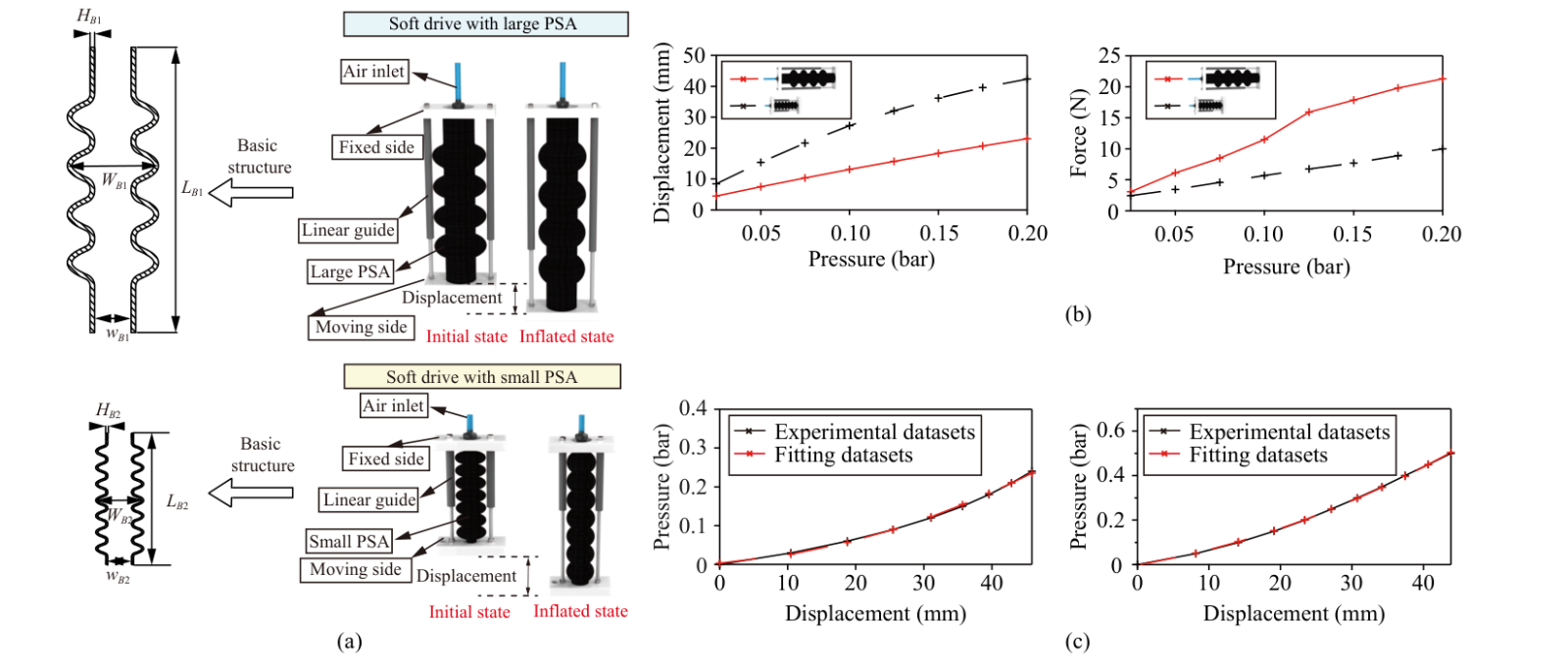
Figure 3. Soft drives. (a) Components and structures of the soft drive with a large PSA (top) and the soft drive with a small PSA (bottom): A PSA made of a silicone tube and a fiber-reinforced layer, two couples of linear guides, a fixed side and a moving side. (b) Pressure-displacement characteristics (left) and pressureforce characteristics (right) of soft drive with large PSA and those of soft drive with small PSA. (c) Fitting results of soft drive with small PSA (left) and those of soft drive with large PSA (right).
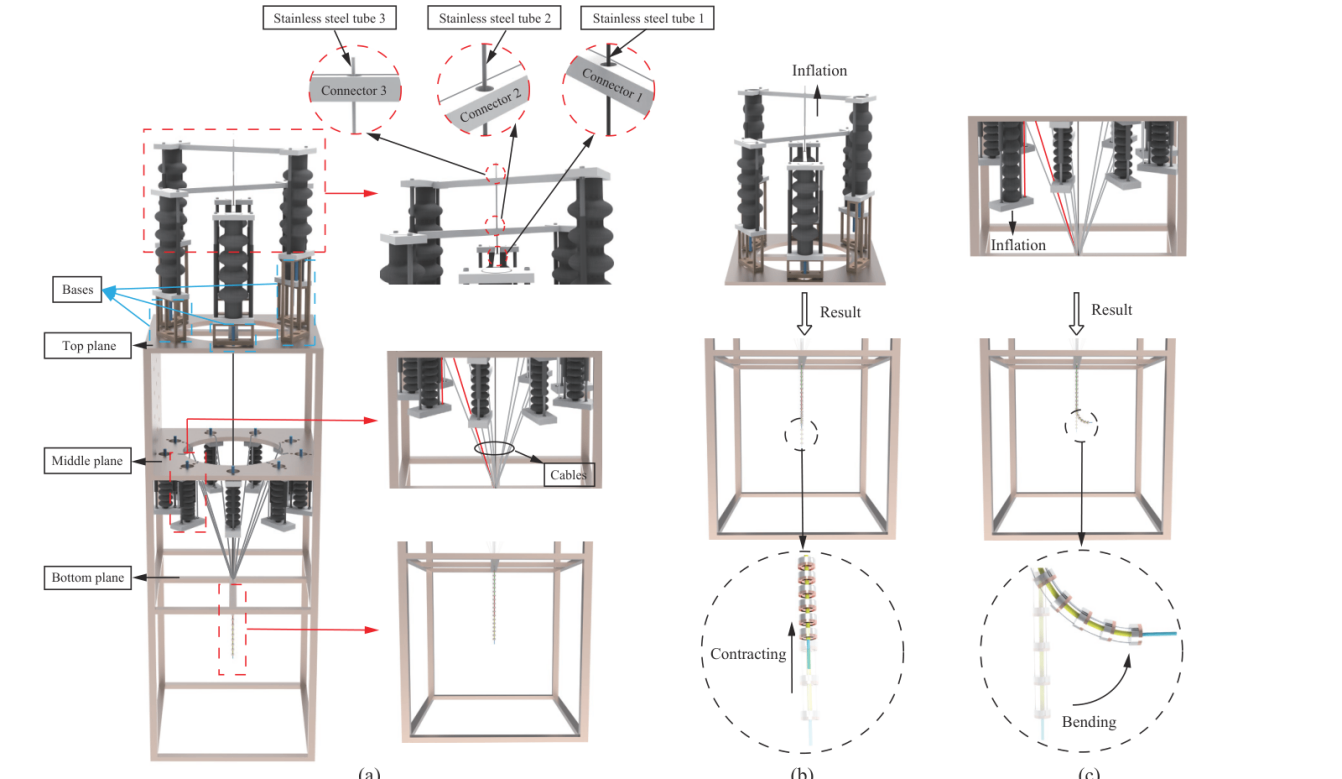
Figure 5. Driving principle of soft drives. (a) Robot system installed on a three-plane frame; (b) Length-varying state wheninflating a pair of soft drives; (c) Bending state when inflating a soft drive with small PSA.
The Role of NOKOV in the Study
A reflective marker was attached to the robot endpoint and tracked by a NOKOV optical motion capture system. The system provided real-time 3D endpoint coordinates for external motion measurement and performance evaluation.
Item | Details |
Tracked object | Robot endpoint |
Marker arrangement | Reflective marker attached to the endpoint |
Output data | Real-time 3D coordinates and endpoint trajectories |
Data use | Performance evaluation and writing-trajectory recording |
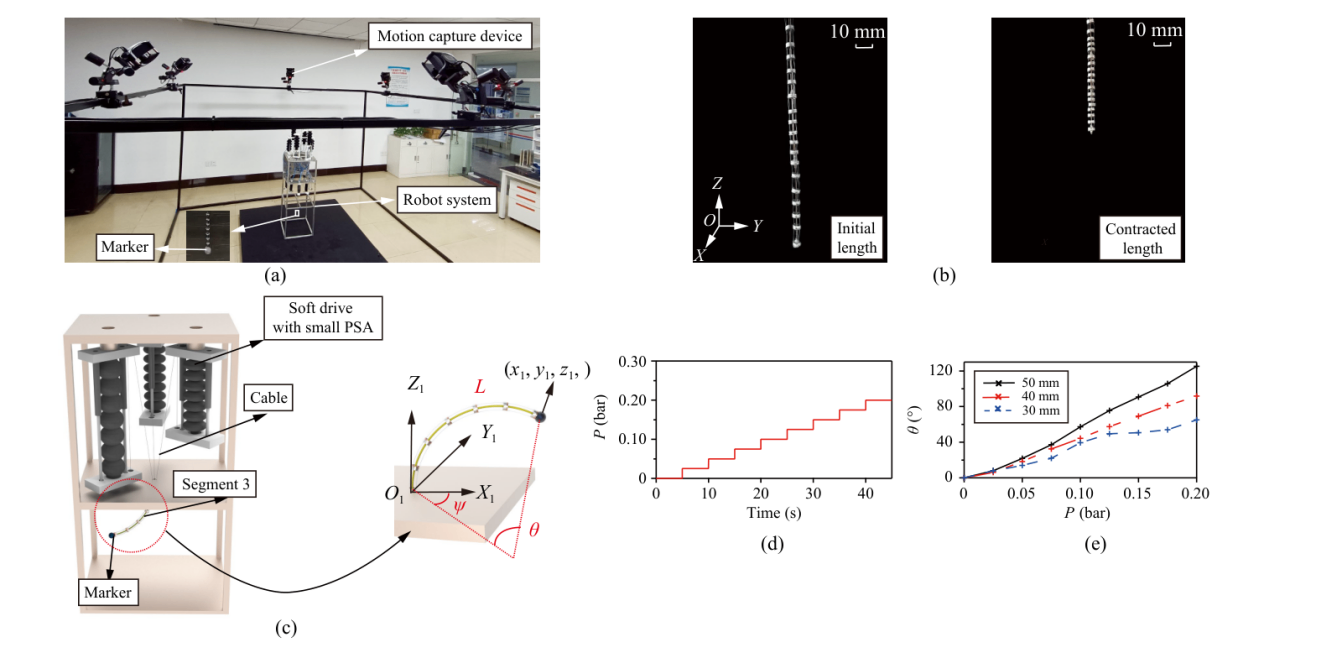
Figure 6. Experimental platforms and results for the length variation test and bending performance tests of the designed CR. (a) Experimental platform forlength variation test. (b) Initial length and contracted length of the backbone.(c) Experimental platform for bending-performance tests; (d) Input pressure for a soft drive with a small PSA of the Segment 3; (e) Bending angles of Segment 3 at different segment lengths.
Experimental Validation
Length-Variation Test
The 150 mm-long backbone achieved more than 70 mm of length variation, corresponding to a length variation rate of 47%.
Bending-Performance Test
Segment 3 was tested at three lengths. Inflating a small-PSA soft drive pulled the corresponding cable and bent the segment, while its length could be adjusted separately.
At the maximum input pressure of 0.2 bar, the measured bending angles were:
Segment 3 length | Maximum bending angle |
50 mm | 125 degrees |
40 mm | 90 degrees |
30 mm | 65 degrees |
The results support the feasibility of using PSA-based soft drives as an alternative to rigid motors.
Robot Task Demonstrations
Digit-Writing Task
The robot endpoint was programmed to write the digits '2' and '6'. During the task, the NOKOV motion capture system recorded the endpoint trajectory in real time, demonstrating flexible and precise motion.
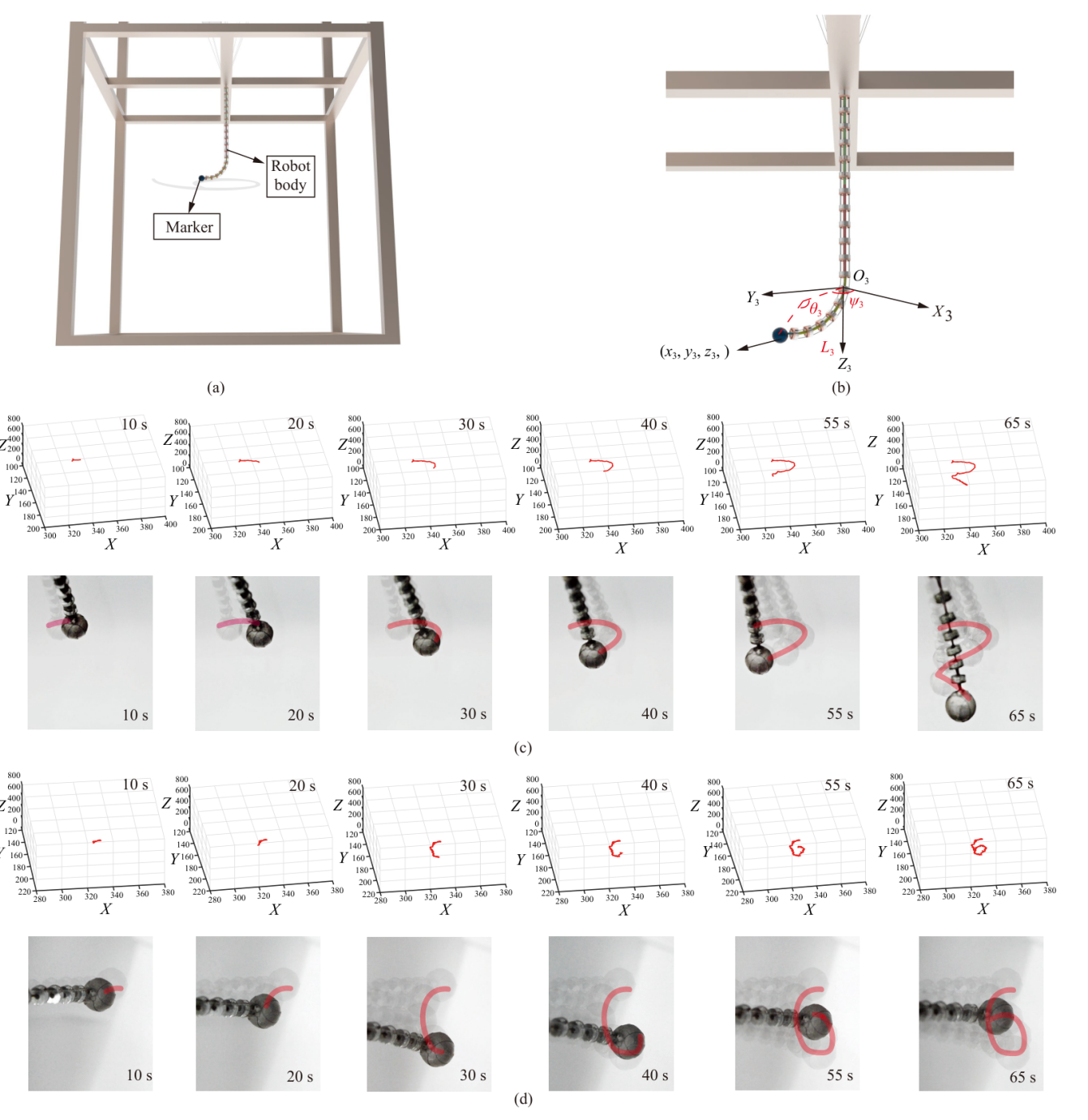
Figure 7. Writing process of the length-variable bionic continuum robot. (a) Experimental platform for the writing tasks; (b) Coordinate system and parameters of Segment 3; (c) Writing process of the number '2'; (d) Writing process of the number '6'.
Narrow-Tube Inspection and Oral Monitoring
The robot was also demonstrated in narrow-tube inspection and oral-monitoring tasks. Compared with a rigidly connected robot, its flexible body and compliant actuation offer greater adaptability in confined environments and safety-sensitive research scenarios.
Paper Information
Paper title: Length-Variable Bionic Continuum Robot With Millimeter-Scale Diameter and Compliant Driving Force
Authors: S. Zhao, Q. Meng, X. Lai, J. She, E. F. Fukushima, and M. Wu
Journal: IEEE/CAA Journal of Automatica Sinica
Publication details: Vol. 12, No. 4, pp. 655-667, April 2025
DOI: 10.1109/JAS.2024.125091
Recommended citation: S. Zhao, Q. Meng, X. Lai, J. She, E. F. Fukushima, and M. Wu, "Length-Variable Bionic Continuum Robot with Millimeter-Scale Diameter and Compliant Driving Force," IEEE/CAA Journal of Automatica Sinica, vol. 12, no. 4, pp. 655-667, April 2025, doi: 10.1109/JAS.2024.125091.
Frequently Asked Questions
What did the NOKOV motion capture system measure?
A reflective marker was attached to the robot endpoint. The NOKOV motion capture system measured its real-time 3D coordinates.
How was the motion capture data used?
The data supported robot performance evaluation and recorded endpoint trajectories during the writing tasks.
How much could the robot change its length?
Starting from an initial backbone length of 150 mm, the robot achieved more than 70 mm of length variation, corresponding to a 47% variation rate.
What bending performance did the robot achieve?
At 0.2 bar, Segment 3 reached maximum bending angles of 125, 90, and 65 degrees at lengths of 50, 40, and 30 mm, respectively.
What tasks were demonstrated?
The study demonstrated digit writing, narrow-tube inspection, and oral monitoring.



 Room820, China Minmetals Tower, Chaoyang Dist., Beijing
 info@nokov.cn
 + 86-10-64922321