Introduction
Prof. Xin Dong’s research team at the University of Nottingham developed an inverse dynamics model for soft parallel robots actuated by multiple dielectric elastomer actuators (DEAs). By incorporating the viscoelastic behavior of dielectric elastomer films, the model calculates actuator voltages for a specified end-effector trajectory and predicts the robot’s output force.
In this study, NOKOV Motion Capture was used to measure the motion of DEA samples and soft parallel robot prototypes. The captured motion data supported electrode ageing analysis, model parameter calibration, trajectory tracking validation, and end-effector force prediction. The proposed model was experimentally validated on DEA-based Delta and five-bar parallel kinematic mechanisms.
Study at a Glance
Item | Result |
Research institution | University of Nottingham, UK |
Research team | Prof. Xin Dong’s research team |
First author | Jung-Che Chang |
Journal | IEEE Transactions on Robotics (T-RO) |
Research topic | Inverse dynamics modeling of DEA-based soft parallel robots |
Research objects | DEA-based Delta and five-bar parallel kinematic mechanisms |
Core method | Inverse dynamics modeling considering the viscoelasticity of dielectric elastomer films |
Motion capture system | NOKOV optical motion capture system |
Tracked objects | DEA sample free ends, Delta PKM end effector, and five-bar PKM tip joint |
Applications | Electrode ageing analysis, model calibration, trajectory tracking validation, and force prediction |
Delta PKM trajectory tracking | 3.2% overall relative RMSE |
Five-bar PKM trajectory tracking | 1.0%–2.2% relative RMSE |
End-effector force prediction | 12.1% relative RMSE during static holding |
Background: Challenges in Modeling DEA-Based Soft Parallel Robots
Soft parallel robots combine the compliance and operational safety of soft robots with the precision, payload capacity, and response characteristics of parallel kinematic mechanisms.
Dielectric elastomer actuators (DEAs) offer compact structures and low transmission losses, making them promising actuators for soft robotic systems. However, dielectric elastomer films exhibit viscoelasticity, hysteresis, and creep. These material properties make it challenging to develop an accurate inverse dynamics model when multiple DEAs work together to drive a robot.
Electrode stability is another challenge. Carbon grease electrodes can lose moisture during storage, potentially changing their conductivity and stiffness and causing actuator performance to deteriorate over time.
To address these issues, the research team developed an inverse dynamics model that accounts for the viscoelastic behavior of dielectric elastomer films, proposed a sandwich-type electrode fabrication process, and experimentally evaluated the performance of two DEA-based parallel robot prototypes.
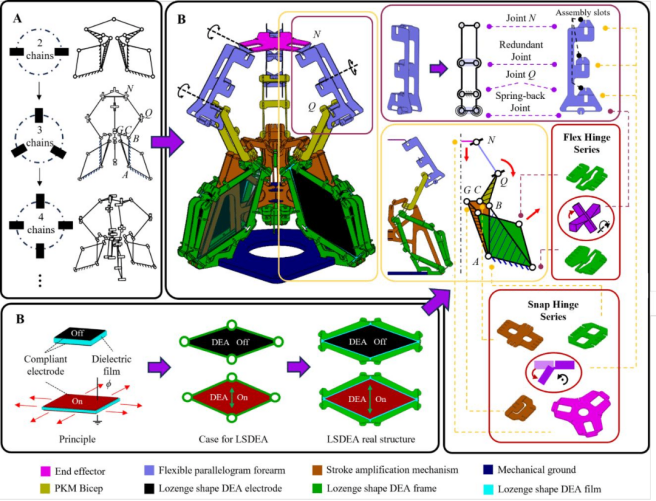
Structural design and working principle of DEA-based soft parallel robots.
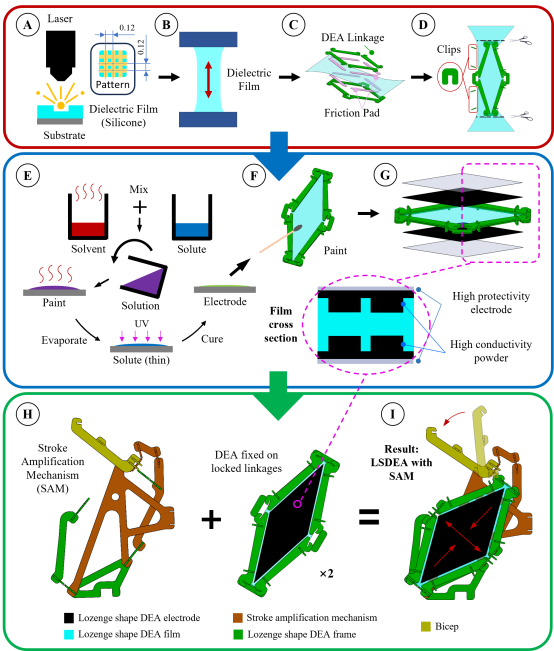
Fabrication process of a lozenge-shaped DEA (LSDEA) with a stroke amplification mechanism (SAM)
Methods Overview: Inverse Dynamics Modeling and Electrode Fabrication
The authors derived an inverse dynamics model to enable coordinated operation among multiple dielectric elastomer actuators (DEAs). Based on the extended Bergstrom–Boyce model [1], the model considers the film's hyperelasticity, hysteresis, and creep, as well as geometric constraints, external forces, and kinetic energy.
The model calculates the actuation voltage required by each DEA based on a desired end-effector trajectory. It can also predict the end-effector output force using the end-effector trajectory and applied actuator voltages as inputs. The model was validated using two DEA-based parallel kinematic mechanisms (PKMs).
The authors also proposed a generic process for fabricating sandwich-type electrodes. It uses laser engraving, solid conductive particles, and photosensitive resin to produce electrodes with improved long-term stability and adhesion to the dielectric elastomer (DE) film. The comparison was based on the time-dependent performance of uniaxially loaded film samples using the proposed paint electrode and carbon grease.
In addition, the team constructed a lightweight robot with stroke-amplifying levers based on 3D puzzling strip structures, significantly reducing the time and financial cost of building a lightweight robot.
Experimental Evaluation
Electrode Ageing and DEA Motion Measurement
The researchers compared the time-dependent dynamic responses of DEA samples fitted with double-layered carbon black paint electrodes (DCPE) and carbon grease electrodes (CGE).
A reflective marker was attached to the free end of each DEA sample, while another marker was placed on the frame to establish a global reference origin. The NOKOV motion capture system tracked the sample motion over time, providing displacement measurements for analyzing changes in actuation stroke.
Compared with the measurements collected on Day 1, the average actuation stroke of the CGE sample decreased by 17.5% on Day 3, 38.4% on Day 7, and 64.3% on Day 14. In contrast, the average stroke variation of the DCPE sample remained within 6%.
These measurements enabled a quantitative comparison of the long-term performance of the two electrode types.
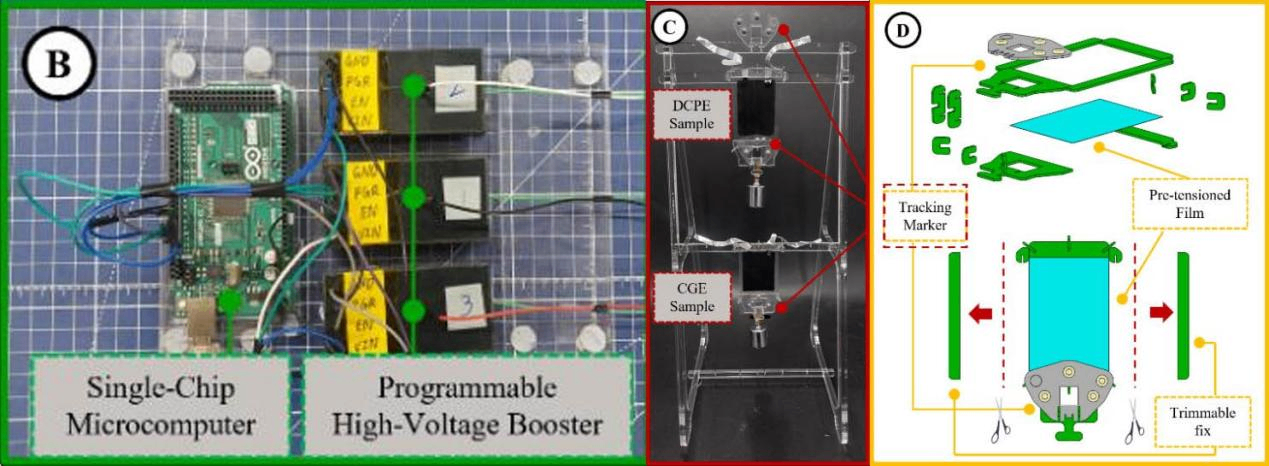
Test of the electrode dynamic behaviour along the ageing.
Model Parameter Calibration of the DEA-Based Delta PKM
The researchers constructed a DEA-based Delta PKM prototype with a total mass of 54.5 g, excluding the mechanical ground.
During calibration, sinusoidal signals were applied simultaneously to the three actuators. NOKOV Motion Capture recorded the actual end-effector motion, and the measured data were used in the inverse dynamics model.
By matching the predicted actuation voltages with the applied voltages, the researchers determined the constitutive parameters of the dielectric elastomer film. They then applied the same signal to one actuator at a time to calibrate the spring-back torque of each forearm torsional joint.
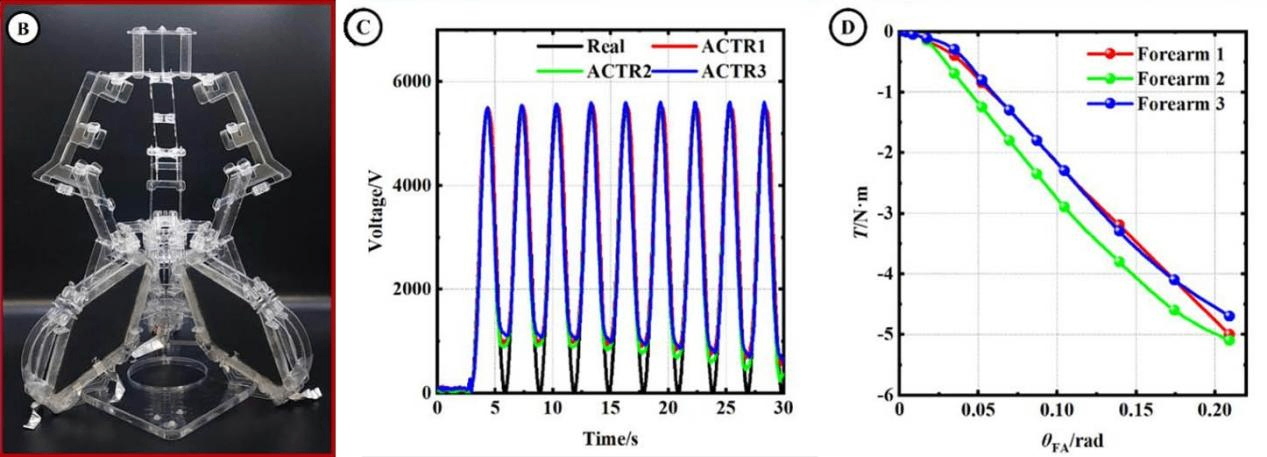
Calibration of the DEA-based Delta PKM
Trajectory Tracking Validation of the DEA-Based Delta PKM
After parameter calibration, the desired trajectory was input into the inverse dynamics model to calculate the required voltage for each actuator. The voltages were then applied through a controller to drive the Delta PKM.
The NOKOV motion capture system recorded the actual end-effector trajectory, which was compared with the planned path to evaluate tracking performance.
The experiments included circular and three-dimensional spiral trajectories. The RMSE values along all three axes were no greater than 3%, and the overall relative RMSE for trajectory tracking was 3.2%.
Model Validation on a Five-Bar Parallel Robot
To further evaluate the versatility of the inverse dynamics approach across different mechanism configurations, the researchers conducted additional experiments using a DEA-based five-bar PKM.
NOKOV Motion Capture recorded the actual trajectory of the robot’s tip joint. The measured trajectories were compared with the planned triangular and square paths.
The relative RMSE values for the tested trajectories ranged from 1.0% to 2.2%, demonstrating the model’s applicability to another DEA-based parallel mechanism.
Validation Experiment
End-Effector Force Prediction
The researchers further evaluated the model’s end-effector force prediction function on the Delta PKM.
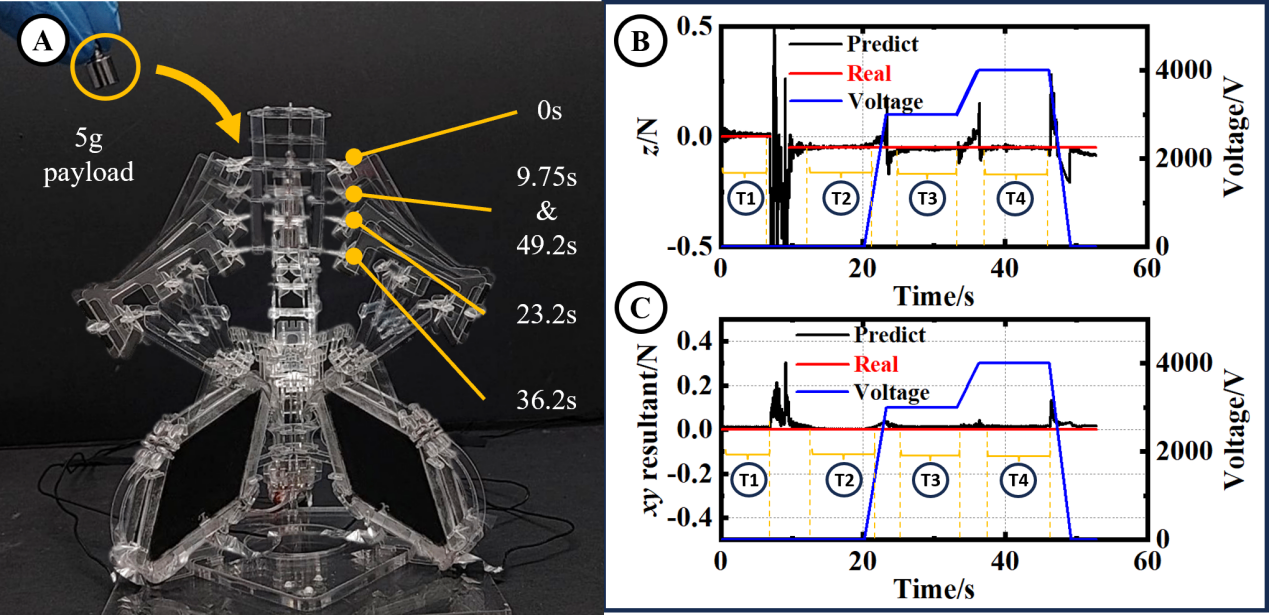
End-effector output force prediction for the DEA-based Delta PKM
A 5 g weight was placed on the robot’s end effector, which was then moved up and down using a predefined actuator voltage signal.
The NOKOV motion capture system recorded the end-effector position. These measured position data were input into the model to predict the output force, and the prediction was compared with the known payload.
During the static holding period, the relative RMSE of the force prediction was 12.1%.
How NOKOV Motion Capture Supports Soft Parallel Robot Research
In this study, NOKOV Motion Capture provided motion measurement data for both individual DEA samples and complete parallel robot prototypes.
Research task | NOKOV measurement | Research application |
Electrode ageing analysis | DEA sample free-end displacement | Measure changes in actuation stroke over time |
Delta PKM calibration | End-effector motion | Calibrate film constitutive parameters and forearm spring-back torque |
Delta PKM validation | Actual end-effector trajectory | Compare measured and planned trajectories |
Five-bar PKM validation | Tip-joint trajectory | Evaluate model performance across different mechanism configurations |
Force prediction validation | End-effector position | Provide motion data for mod |
By tracking reflective markers on the DEA samples and robot prototypes, NOKOV Motion Capture provided objective motion measurements for actuator characterization, model calibration, and experimental validation.
The study demonstrates how optical motion capture can support the development and evaluation of DEA-based soft parallel robots, from actuator-level performance analysis to robot-level trajectory tracking and force prediction.
Reference
[1] G.-Y. Gu, U. Gupta, J. Zhu, L.-M. Zhu, and X. Zhu, "Modeling of viscoelastic electromechanical behavior in a soft dielectric elastomer actuator," IEEE Transactions on Robotics, vol. 33, no. 5, pp. 1263-1271, 2017.
Frequently Asked Questions
Q1: How can motion capture be used to validate inverse dynamics models for soft parallel robots?
Motion capture records the actual end-effector trajectory of a robot, allowing researchers to compare measured motion with the planned trajectory and calculate tracking errors. In this study, NOKOV Motion Capture was used to validate the trajectory tracking performance of DEA-based Delta and five-bar parallel robots.
Q2: How is motion capture data used for model parameter calibration in DEA-based robots?
Motion capture provides measurements of the actual robot motion under applied actuator voltage signals. In the Delta PKM experiment, the measured end-effector motion was used with the inverse dynamics model to determine the dielectric elastomer film constitutive parameters by matching predicted and applied voltages. The spring-back torque of the forearm torsional joints was also calibrated.
Q3: What trajectory tracking accuracy was achieved by the DEA-based parallel robots?
The DEA-based Delta PKM achieved an overall relative RMSE of 3.2%, with RMSE values along all three axes no greater than 3%. The five-bar PKM achieved relative RMSE values ranging from 1.0% to 2.2% for the tested triangular and square trajectories.
Q4: Can motion capture help validate end-effector force prediction in soft robots?
Yes. Motion capture can provide end-effector position data for model-based force prediction. In this study, NOKOV Motion Capture recorded the position of the Delta PKM end effector under a 5 g payload. The model achieved a relative RMSE of 12.1% during the static holding period.
Paper Information
Paper Title: Inverse Dynamic Modeling of Soft Parallel Robots Actuated by Dielectric Elastomer Actuators
Authors: Jung-Che Chang, Xi Wang, Fengze Yang, Dragos Axinte, and Xin Dong
Affiliation: University of Nottingham, UK
Journal: IEEE Transactions on Robotics (T-RO)
DOI: 10.1109/TRO.2026.3741520
Citation:
J.-C. Chang, X. Wang, F. Yang, D. Axinte, and X. Dong, "Inverse Dynamic Modeling of Soft Parallel Robots Actuated by Dielectric Elastomer Actuators," IEEE Transactions on Robotics, doi: 10.1109/TRO.2026.3741520.
About the Authors
Jung-Che Chang is a Research Fellow at the University of Nottingham, Nottingham, U.K. His research interests include compliant and soft mechanisms and robotics for challenge and extreme environments with applications in Aerospace, Nuclear, Oil & Gas, and Construction.
Xi Wang is a Research Fellow at the Rolls-Royce University Technology Centre (UTC) in Manufacturing & On-Wing Technology at the University of Nottingham, where he completed his Ph.D. in Manufacturing Engineering in 2024. His main research focuses on soft and continuum robots, flexible tactile sensing, and multimodal perception, aiming to develop smart inspection and operation solutions for confined spaces in aircraft engines, wings, and nuclear facilities.
Fengze Yang is pursuing a Ph.D. in manufacturing engineering at the University of Nottingham. His research interests include electroactive soft actuators, particularly HASEL and dielectric elastomer actuators, and self-growing robotic systems for confined environments. His work involves actuator fabrication and experimental characterisation, as well as robotic deployment in narrow and difficult-to-access spaces.
Dragos Axinte is Professor of Manufacturing Engineering in the Faculty of Engineering at the University of Nottingham and Director of the Rolls-Royce University Technology Centre (UTC) in Manufacturing & On-Wing Technology.
Xin Dong (corresponding author) is an Associate Professor at the University of Nottingham. His research interests are extra slender continuum robot and reconfigurable hexapod robots with novel actuation solutions for the application in Aerospace, Nuclear, Oil & Gas, Marine and rescue.


 Room820, China Minmetals Tower, Chaoyang Dist., Beijing
 info@nokov.cn
 + 86-10-64922321