Overview
How can a swarm of autonomous aerial vehicles surround several moving targets when the scene is cluttered and the vehicles cannot depend on explicit neighbor communication? A team led by Han Zhou at the National University of Defense Technology addressed this problem in the paper “Density-Based Probabilistic Graphical Models for Adaptive Multi-Target Encirclement of AAV Swarm,” published in IEEE RA-L. The study introduces a density-based probabilistic graphical model (DB-PGM) that converts local spatial density into adaptive swarm actions; in the physical validation, NOKOV motion capture system tracked Crazyflie poses at 90 Hz for the ROS-Simulink closed loop. When AAV R7 malfunctioned at 43.8 s, the remaining vehicles continued the task and encircled both targets at 68.9 s, providing a concrete test of adaptive and fault-tolerant multi-target encirclement.
Why is multi-target encirclement a hard control problem?
The task combines pursuit, collision avoidance, formation adaptation and task continuity. Artificial potential-field approaches are effective for basic geometries but are constrained when the desired perimeter is irregular. Pattern-formation methods can adapt, yet often depend on predefined formations or intricate pattern functions. Reinforcement-learning approaches may improve flexibility, but large swarms increase the learning space and the cost of training and reward design. These limitations become visible when targets change their relative positions or obstacles split the available paths.
How does DB-PGM make a distributed decision?
Each encircling AAV maintains a directed perception-decision graph with a decision node and perception nodes for neighbor density, collision avoidance and target density. Local observations update the probability parameters. Maximum-a-posteriori inference then selects a discrete acceleration magnitude and direction. Because the decision is local and distributed, the swarm can split into clusters, adjust its perimeter and respond to target-formation changes without loading a fixed formation template. In the physical validation stage, NOKOV supplies 90 Hz pose data so the DB-PGM state and the Crazyflie motion can be evaluated in the same closed loop. The same distributed decision path is evaluated for fault-tolerant multi-agent encirclement when one vehicle fails.
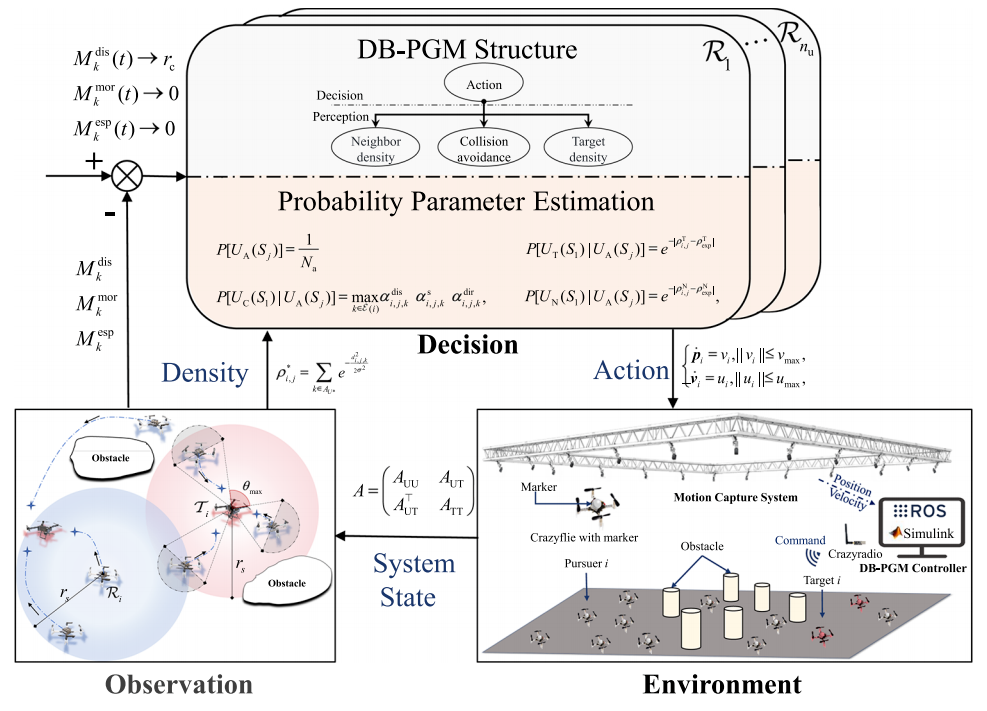
Figure 1. DB-PGM perception-decision loop and the motion-capture-supported experimental architecture
What was measured in the physical experiment?
The real-world setup used up to 10 Crazyflie quadrotors in a 5.5 m x 10 m arena with six cluttered obstacles. A 90 Hz NOKOV motion capture system tracked the Crazyflie poses. The measurements entered a ROS-Simulink closed-loop controller, while Crazyradio modules transmitted commands to the vehicles. This measurement path gives the controller a time-resolved pose state and gives researchers a common reference for evaluating trajectories, formation changes and failure recovery.
Experiment element | Reported setup | Validation purpose |
Motion capture | NOKOV mocap, 90 Hz pose tracking | Real-time pose state for closed-loop control |
Vehicles | Up to 10 Crazyflie quadrotors | Multi-vehicle validation |
Arena | 5.5 m x 10 m | Controlled physical test space |
Obstacles | Six cluttered obstacles | Local perception and avoidance constraints |
Control stack | ROS-Simulink + Crazyradio | Connects measurement, decision and execution |
What happened after one vehicle failed?
The experiment included a partial-failure test. NOKOV recorded the Crazyflie pose stream around the event, allowing the pose state before and after the failure to be compared. AAV R7 malfunctioned and crashed at t = 43.8 s. The remaining vehicles continued to adjust their positions and successfully encircled both targets at t = 68.9 s. The result supports a measured claim of task continuity and fault tolerance under the reported conditions. It should not be read as a guarantee that failures are harmless or that the same outcome will hold in every outdoor environment.
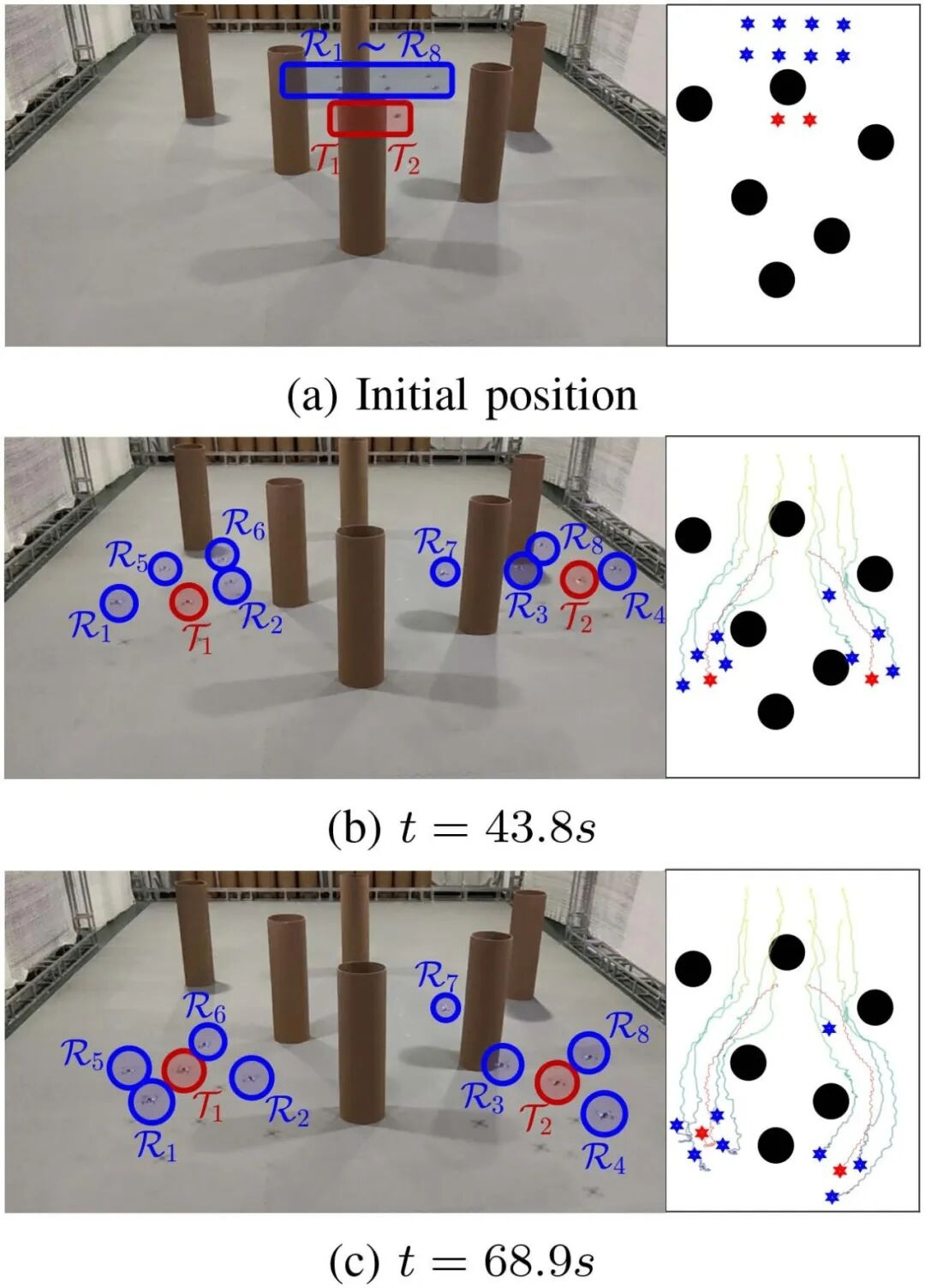
Figure 2. Physical experiment snapshots: initial state, R7 malfunction at 43.8 s, and successful two-target encirclement at 68.9 s.
What did the simulations examine?
The simulations primarily evaluate the algorithm under changing conditions; NOKOV is used in the subsequent physical validation stage to provide 90 Hz Crazyflie pose data for the closed loop. Five simulation studies examined cluttered multi-target encirclement, adaptive formation without predefined configurations, dynamic adjustment to changing target formations, robustness under noise against a density-interaction benchmark, and performance across sensing radii and velocity ratios. Together, these tests evaluate whether local probabilistic decisions remain useful when the geometry, sensing conditions and target motion change.
Why is the NOKOV measurement role important?
In a physical swarm experiment, an algorithmic state estimate must be connected to the vehicles’ actual motion. NOKOV supplies the real-time pose stream used by the controller and the evaluation process. That makes it possible to see when a vehicle fails, how the swarm density changes afterwards, and whether the final trajectories satisfy the encirclement task. The broader lesson is that adaptive multi-agent control needs both a decision model and a measurable physical reference.
What can robotics teams take from this case?
The paper provides a route from distributed probabilistic reasoning to physical multi-target encirclement. It is relevant to research on cooperative pursuit, aerial surveillance, search and rescue, and other multi-agent tasks where centralized formation scripts are undesirable. The authors identify active exploration, unstructured obstacles, perception relay and end-to-end perception validation as future directions, defining the current scope of the evidence.
FAQ
Q1: Does DB-PGM require a predefined formation?
A: No. Each AAV adapts from local density and probabilistic inference.
Q2: Does it require explicit inter-vehicle communication?
A: The proposed decision process uses local perception and does not rely on explicit real-time communication between encircling AAVs.
Q3: Why this research use NOKOV optical motion capture?
A: The closed-loop controller needs a time-resolved pose state, and the experiment needs a common reference for validating physical motion.
Q4: What did NOKOV provide for this Research?
A: 90 Hz real-time pose tracking for the Crazyflie vehicles in the ROS-Simulink control loop.
Q5: What is the direct fault-tolerance result?
A: After R7 failed at 43.8 s, the remaining vehicles encircled both targets at 68.9 s.
Citation
Huang, Yixin, et al. "Density-Based Probabilistic Graphical Models for Adaptive Multi-Target Encirclement of AAV Swarm." IEEE Robotics and Automation Letters 10.8 (2025): 8228-8235.



 Room820, China Minmetals Tower, Chaoyang Dist., Beijing
 info@nokov.cn
 + 86-10-64922321