A concentric tube robot (CTR) navigating a narrow lumen must keep its entire body on the planned path, not merely its tip. A Southeast University team’s TASE 2025 paper moves whole-body shape control from position space to the curvature domain, enabling continuous steering at 0.1–0.3 s per frame in Python on a single CPU. In the physical bronchial-phantom experiment, NOKOV motion capture calibrated the relative pose between the robotic manipulator and the bronchial model, aligning the physical setup with the planned simulation.
Why Tip-Only Control Is Insufficient
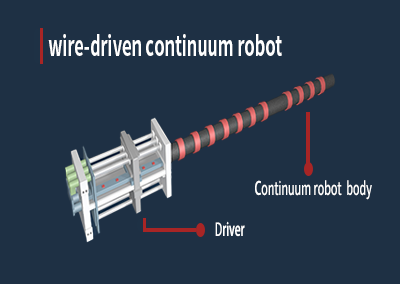
A CTR is a nested assembly of pre-curved elastic tubes; sliding and rotating the tubes relative to one another changes its spatial shape, which suits minimally invasive surgery in confined lumens. Most existing controllers track only the pose of the innermost tube’s tip, ignoring the overall shape. As the robot advances through curved anatomy, intermediate segments can contact surrounding tissue, risking injury and degrading control. Full-shape optimization is computationally costly and yields poor temporal continuity, and the follow-the-leader strategy cannot accurately follow general freeform paths within the CTR’s limited motion space.
Tip-Only vs. Whole-Body Steering: What Differs
In the freeform-path experiment (a curved skeleton extracted from a bronchial model), the paper compared the two strategies directly:
Dimension | Tip-only control | Whole-body continuous steering |
Control target | Tracks only the tip pose | Fits the entire curve to the target in curvature space |
Behavior on freeform paths | Tip tracks well; middle segments misalign | Whole body stays aligned with the skeleton |
Applicable scenarios | Simple, straight lumens | Bending, branching, safety-critical anatomy |
Table 1. Tip-only vs. whole-body continuous steering on freeform paths (source: paper results).
Method: Optimization in the Curvature Domain
Directly optimizing the full shape in position space is slow. For stiffness-dominant CTRs, curvature is essentially independent of tube rotation; only the jump points of the piecewise-constant curvature shift with tube extension. The method therefore splits the problem: first optimize tube extension to fit the target curvature, then search tube rotations to fit the target shape. With fewer variables, one frame of continuous steering takes 0.1–0.3 s in Python on a single CPU.
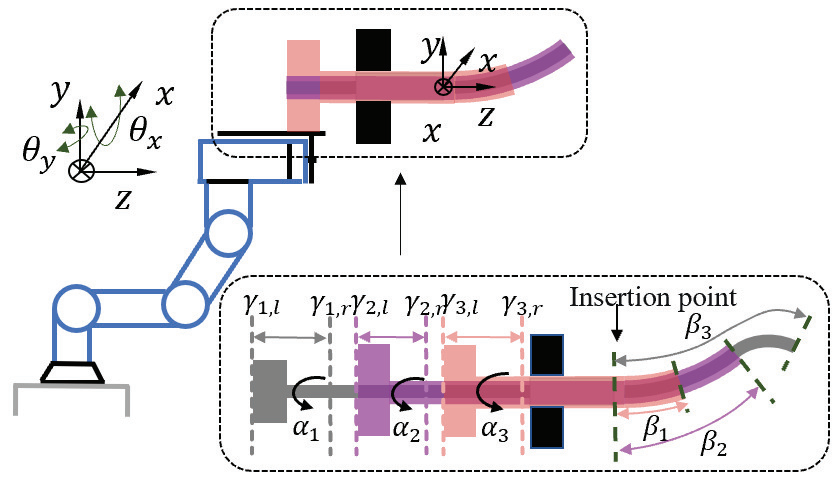
Figure 1. Concentric tube robot and its configuration parameters: the UR3 arm provides global rotation; three pre-curved tubes shape the robot through extension (α1–α3) and rotation (β1–β3).
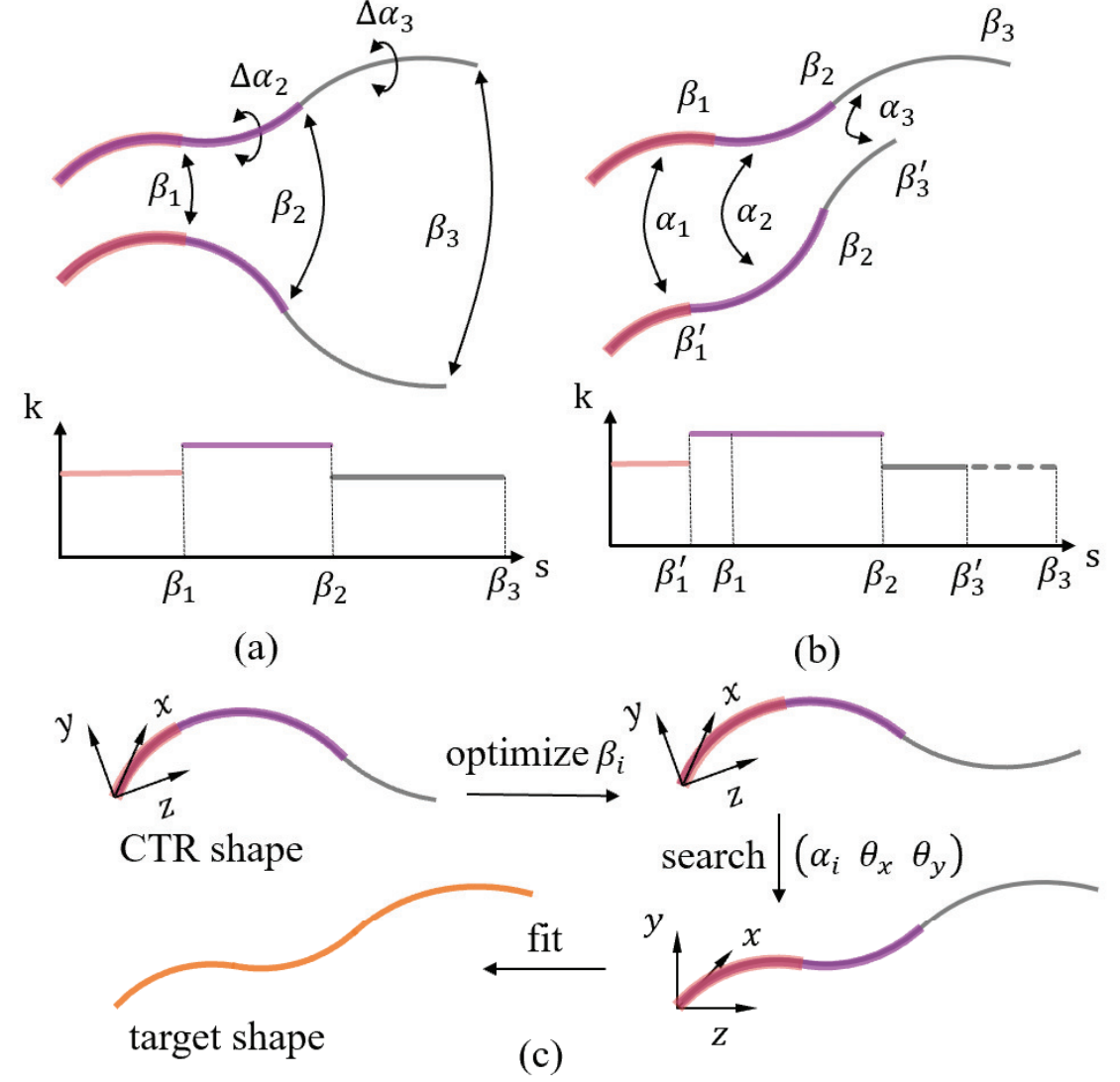
Figure 2. Curvature-domain strategy: (a) curvature is unaffected by tube rotation; (b) extension shifts the jump points of the piecewise-constant curvature; (c) extension is optimized first, then rotation is searched to fit the target shape.
Validation: Simulation and a Physical Phantom
Four experiments were conducted. On primitive shapes (cosine, arc, straight line, composite), the CTR followed each target smoothly and continuously. On time-varying shapes, it stayed well aligned and outperformed the baseline for large-scale variations. On the freeform bronchus skeleton, the whole body tracked the path consistently, whereas tip-only control left intermediate segments misaligned. The planned bronchial path was then executed physically with PCL 3D-printed concentric tubes, six stepper motors, a UR3 robotic arm providing global rotation, and a 3D-printed bronchial model. Overlaying the simulation on the captured real-world data, the researchers observed the CTR continuously keeping its entire shape aligned with the centerline.
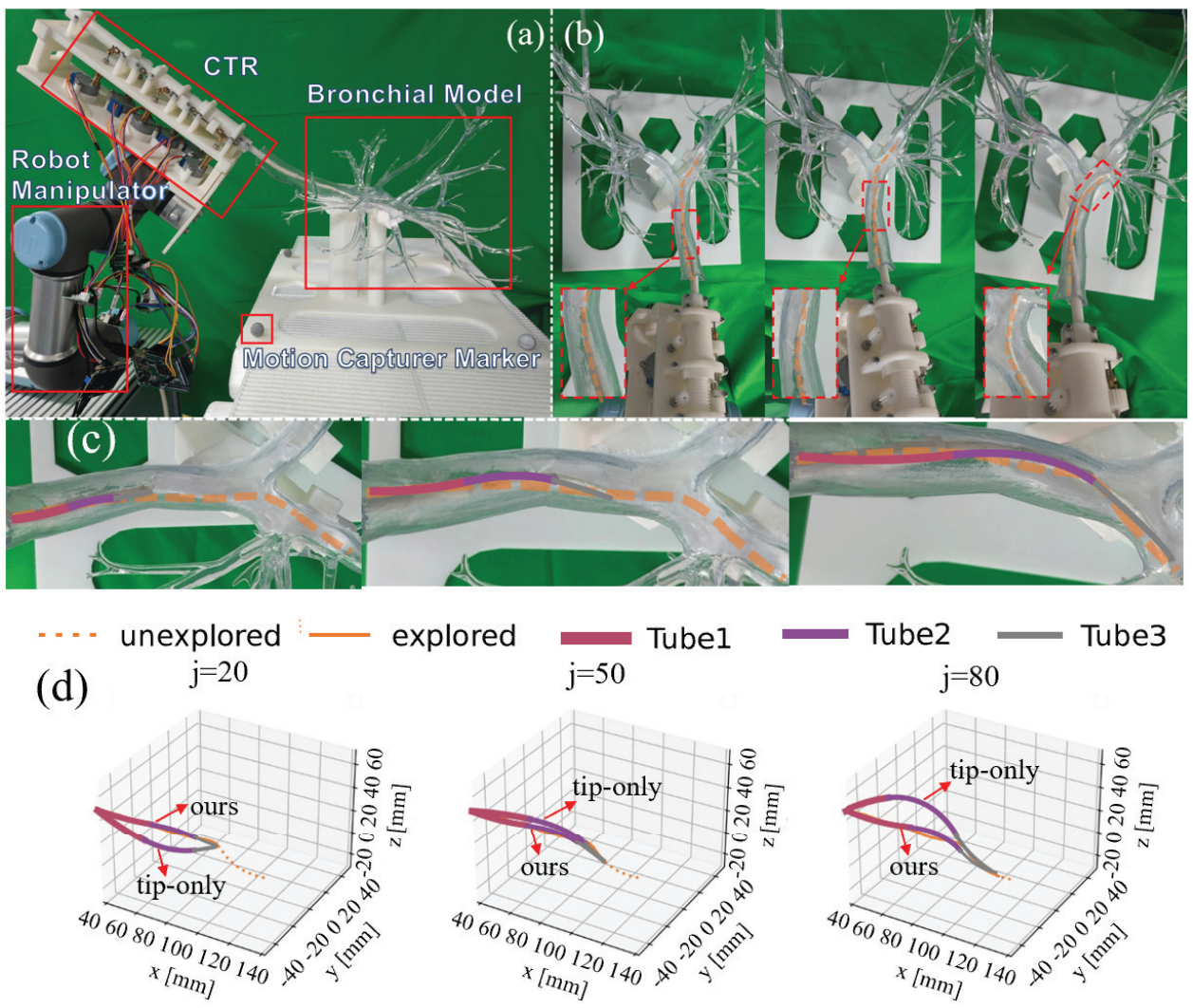
Figure 3. Physical bronchial-phantom experiment: (a) setup with NOKOV retro-reflective markers on the manipulator and the phantom fixture; (b) the CTR advances through the bronchial model with its whole body aligned with the centerline; (c) zoomed comparison of experimental and simulated results; (d) path-following on the freeform curve: proposed method vs. tip-only control.
Key Results
Metric | Value | Interpretation |
Per-frame computation | 0.1–0.3 s (Python, single CPU) | Feasible on an ordinary industrial PC; no GPU cluster required |
Primitive-shape tracking | Cosine / arc / line / composite | Covers the most common geometric paths |
Time-varying shapes | Better than baseline for large-scale changes | Suitable for dynamic targets or breathing-induced motion |
Freeform-path alignment | Whole body aligned; tip-only leaves mid segments off-path | Lower tissue-collision risk |
Table 2. Key results and their interpretation (source: paper).
The 0.1–0.3 s per-frame cost indicates continuous steering is feasible in real time on standard hardware; the j=20/50/80 steps show the alignment gap between the proposed method and tip-only control widening as the path lengthens.
Implications
Stiffness-dominant structures are common in continuum robotics, so curvature-domain control offers a transferable way to reduce computation and improve control continuity. Whole-body alignment also implies lower tissue-collision risk, with direct benefit to force feedback, preoperative planning, and intraoperative navigation.
Why the Experiment Required Motion Capture
The manipulator and the 3D-printed bronchial model were mounted independently, with no mechanical alignment. Without a spatial reference between the two coordinate frames, a simulated path cannot be transferred to the physical robot. Using retro-reflective markers on the manipulator and the phantom fixture, NOKOV motion capture calibrated the relative pose between the robotic manipulator and the bronchial model, establishing the spatial correspondence between the physical setup and the planned simulation. It then acquired poses continuously, so simulated and captured trajectories could be overlaid to determine whether the whole CTR body stayed on the centerline.
Motion Capture in Continuum Robotics
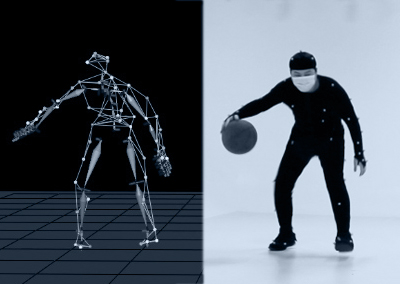
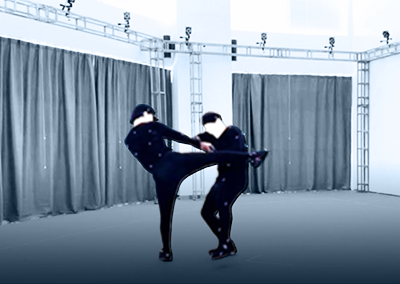
Continuum robots differ from conventional rigid-link robots because their bodies can continuously deform or change shape. For this reason, evaluating only the robot tip may not fully describe whether the robot is following its intended path.
In continuum robotics research, motion capture can support several experimental tasks:
1. Coordinate-frame calibration: Establish the spatial relationship between independently mounted robotic components, phantoms, or external reference objects.
2. Robot trajectory measurement: Continuously capture the physical motion of the robot or its tracked components during experiments.
3. Robot trajectory validation: Compare measured trajectories against planned or simulated paths to evaluate path-following performance.
4. Simulation-to-real validation: Overlay physical experimental data with simulation results to assess how well the planned motion transfers to the real setup.
5. Whole-body motion evaluation: Provide external measurements that can help assess whether the robot body remains aligned with a target path rather than evaluating only its tip.
The TASE 2025 CTR experiment demonstrates this workflow in a physical bronchial-phantom environment.
Key Takeaway
In continuum robotics experiments, optical motion capture can provide an external spatial reference for coordinate-frame calibration, continuous trajectory measurement, and simulation-to-real validation. In this CTR study, NOKOV motion capture helped align the physical manipulator and bronchial phantom with the planned simulation and enabled captured trajectories to be overlaid with simulated results.
FAQ
Q1. Is tip-only control sufficient for a CTR in a narrow lumen?
No. Intermediate segments drift off target in curved or branching lumens, risking tissue contact and injury; safety-critical procedures require whole-body shape control.
Q2. Why is curvature-domain optimization faster?
For stiffness-dominant CTRs, rotation barely affects curvature, and extension shifts only the piecewise-constant-curvature jump points. Splitting extension optimization from rotation search reduces the variables, giving 0.1–0.3 s per frame in Python on one CPU.
Q3. Why did the physical experiment need NOKOV motion capture?
The manipulator and the phantom were mounted separately; their coordinate frames had to be aligned before simulated paths could be executed. NOKOV calibrated the manipulator–model relative pose and acquired poses continuously for trajectory overlay.
Q4. How does the method compare with tip-only control on freeform paths?
The entire body stays aligned with the extracted bronchial skeleton, while tip-only control leaves intermediate segments visibly misaligned; the gap grows with path length (j=20/50/80).
Q5. Which clinical scenarios can benefit?
Continuum-robot applications in narrow, curved, safety-critical lumens: bronchoscopy, laparoscopy, cardiovascular intervention, and natural-orifice surgery.
Citation
L. Xie, L. Zhu, X. Jin and A. Song, "Curvature-Based Continuous Steering of Stiffness-Dominant Concentric Tube Robots," in IEEE Transactions on Automation Science and Engineering, vol. 22, pp. 15565–15575, 2025, doi: 10.1109/TASE.2025.3570861.




 Room820, China Minmetals Tower, Chaoyang Dist., Beijing
 info@nokov.cn
 + 86-10-64922321