At IROS 2026, a research team led by Prof. Chenxi Xiao from the School of Information Science and Technology at ShanghaiTech University presented the paper “CoLI: A Reproducible Platform for Continuum Robot Learning via Monolithic 3D Printing and Isomorphic Teleoperation.” The paper introduces CoLI, a reproducible, learning-ready, open-source continuum robot platform. In the study, the NOKOV motion capture system measured the end-effector positions and motion trajectories of the leader and follower robots, supporting position measurement and validation of the tracking accuracy and dynamic response of isomorphic teleoperation. The teleoperated demonstrations collected on the platform were then used for continuum robot imitation learning experiments.
Study at a Glance
Item | Result |
Motion capture system | NOKOV optical motion capture system (five Mars 1.3H cameras) |
Tracked objects and measurements | End-effector position relative to the base, and motion trajectories, of the leader and follower robots |
Mean positional tracking error | 8.2 mm (127 configurations; about 3.3% of the 243 mm arm length) |
Reported mean settling-time latency | 158 ms (12 trajectories) |
Maximum reliable payload under dynamic operation | 1 kg (as defined under dynamic operation) |
Autonomous task success | 12/12, 10/12, 10/12 |
Background: Why Continuum Robot Learning Needs a Reproducible Platform
Continuum robots feature continuously deformable, compliant structures that enable dexterous and safe manipulation in unstructured and confined environments. However, their adoption in data-driven robot learning remains limited. Accessible hardware is scarce: existing designs often rely on customized components, resulting in complex fabrication and assembly, high costs, and poor reproducibility. Continuous deformation and high-dimensional actuation also introduce actuation redundancy and coupling among degrees of freedom, making accurate modeling and calibration challenging. Task-space teleoperation further faces workspace mismatch between the operator and the robot. A continuum robot platform that is easy to fabricate, intuitive to control, and ready for learning is therefore needed.
Methods Overview: Monolithic 3D Printing, Isomorphic Teleoperation, and Motion-Capture Position Measurement
To address the challenges of fabrication, control, and demonstration data collection, the study integrates monolithic fabrication, isomorphic teleoperation, and a standardized learning pipeline into one open-source platform, CoLI. Its main contributions are:
1) A monolithic multi-material fabrication paradigm that enables single-run, reproducible manufacturing of continuum robots for scalable research deployment.
2) An isomorphic teleoperation framework that facilitates actuator-level teleoperation and demonstration collection for imitation learning.
3) A learning-ready continuum robot platform integrated with the LeRobot framework, bridging continuum robot hardware and embodied AI pipelines.
4) System-level validation across structural functionality, teleoperation, and autonomous manipulation, establishing a reproducible baseline for continuum robot learning.
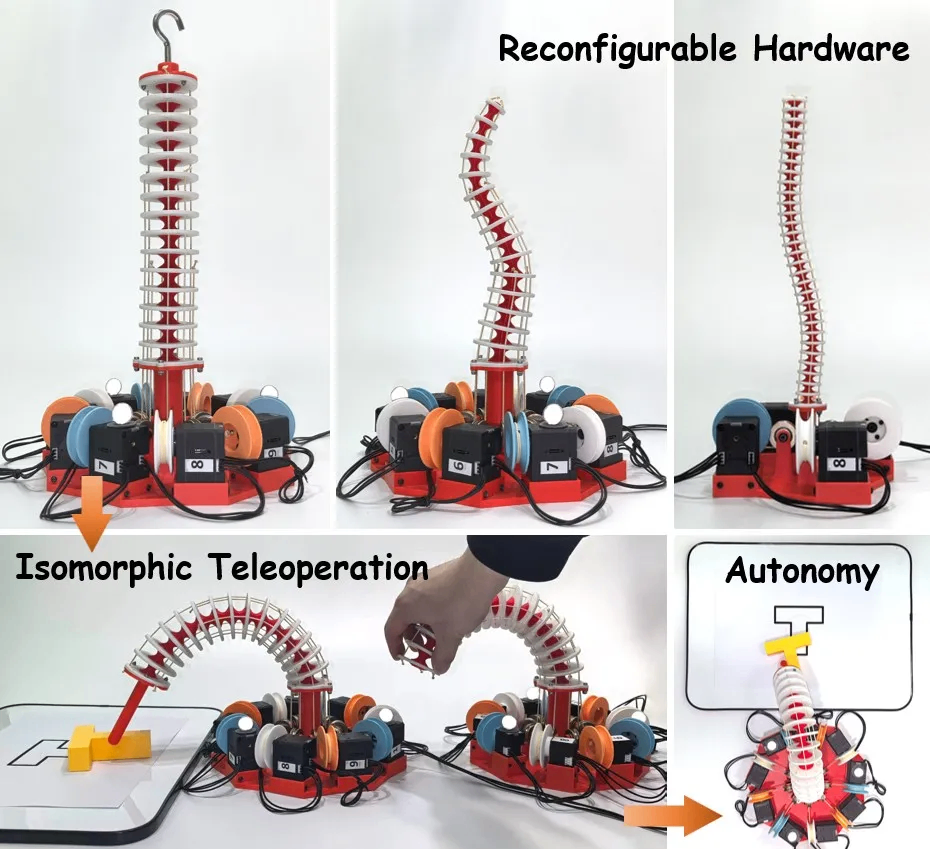
Figure 1. Overview of the proposed monolithic 3D-printed continuum robot platform with isomorphic teleoperation and imitation-learning-based autonomous control.
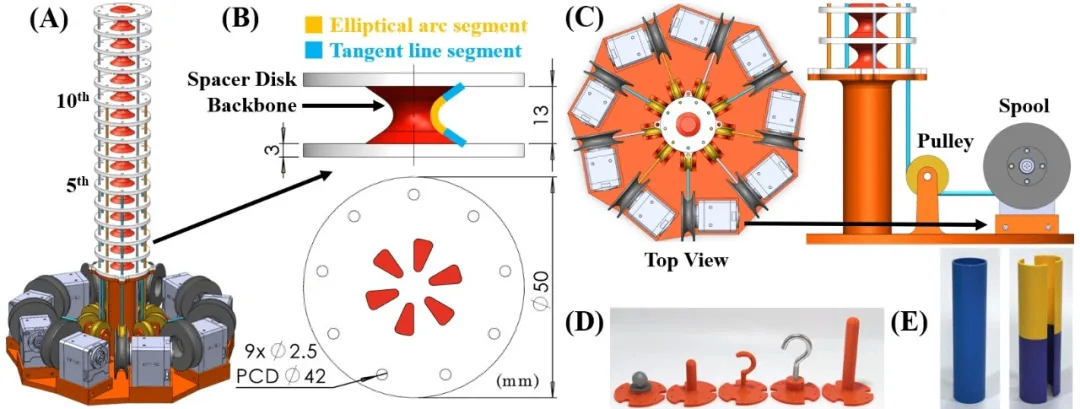
Figure 2. Structure of the proposed continuum robot: (A) structural body and cable routing, (B) joint structure between adjacent disks, (C) actuation mechanism, (D) end effectors, and (E) calibration tools.
The CoLI robot body is fabricated as a monolithic structure through multi-material 3D printing: the flexible backbone and rigid spacer disks are printed together in a single run, leaving only tendon routing and actuator assembly. The number of joints, dimensions, and robot configuration can be customized for specific tasks.
Isomorphic teleoperation adopts a leader–follower configuration. The two robots share the same continuum structure and tendon-routing layout but use different motor models to meet the requirements of manual operation and motion tracking. The operator directly bends the leader by hand, and the leader motor encoder positions are mapped directly to follower commands without solving robot kinematics. This process also records actuator-level demonstrations suitable for imitation learning. The platform is integrated with LeRobot, where teleoperated demonstrations are used to train a task-specific ACT (Action Chunking with Transformers) policy for autonomous manipulation. Because the follower must track the leader’s position accurately, the study used the NOKOV motion capture system to measure and validate tracking accuracy and dynamic response.
Experimental Evaluation
Continuum Robot Performance Characterization
The study evaluated the robot body through force–deformation testing, workspace analysis, payload experiments, and durability testing. The flexible backbone exhibited an approximately linear restoring-force–deformation relationship (slope: approximately 3.2 N/mm). A reachable workspace approximating a 430 mm-diameter sphere was computed using a Piecewise Constant Curvature (PCC) model. Under teleoperation, the robot remained fully controllable with a 1 kg end-effector payload; at 1.2 kg, its control performance noticeably deteriorated. The maximum reliable dynamic payload was therefore defined as 1 kg. The same pair of leader and follower robots operated for more than 15 hours in total without observable structural damage, tendon slackening, or degradation in control performance. The robot also operated continuously for more than 90 minutes without failure.
Isomorphic Teleoperation Tracking Accuracy and Dynamic Response: NOKOV Position Measurement and Validation
The study used a NOKOV optical motion capture system to measure each robot’s end-effector position relative to its own base.
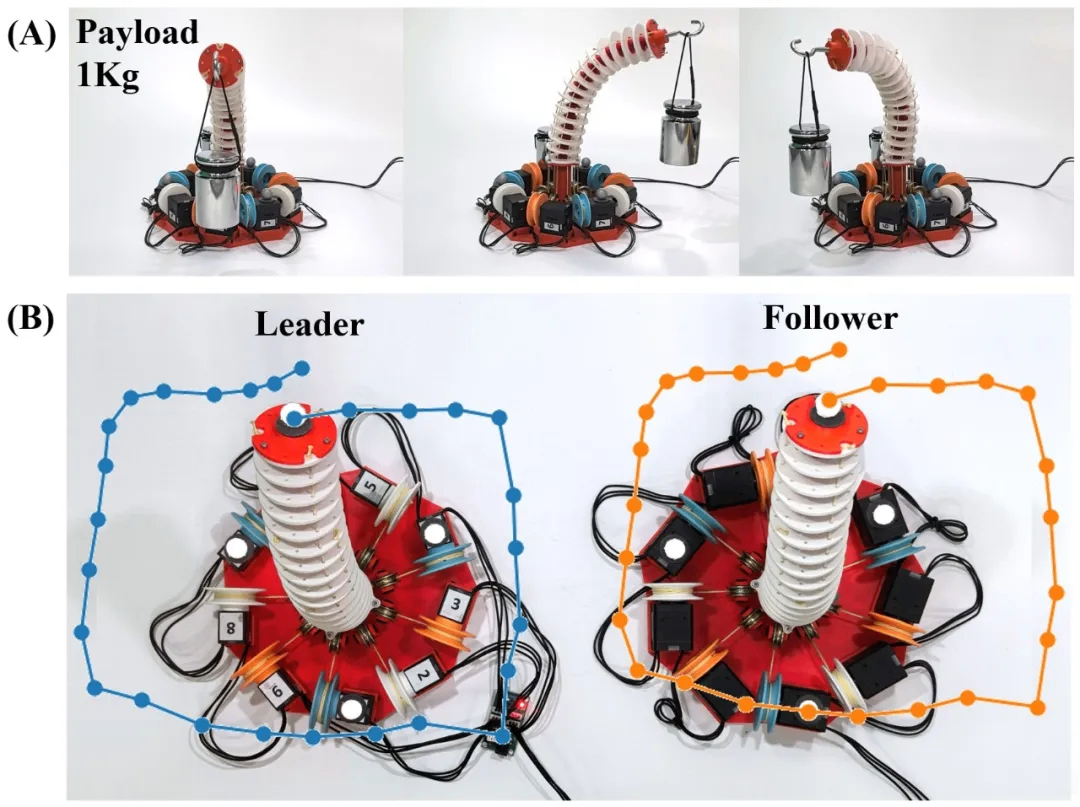
Figure 3. (A) Payload evaluation with a 1 kg load. (B) Teleoperation trajectories of the leader and follower robots.
In the tracking accuracy experiment, the operator manually bent the leader to drive the follower. Once both robots reached a target configuration and remained stationary, the end-effector positions relative to their respective bases were recorded simultaneously to calculate tracking error. Across 127 configurations, the mean positional tracking error was 8.2 mm, equivalent to approximately 3.3% of the robot’s 243 mm arm length. In the dynamic response experiment, the same motion capture setup was used to record leader and follower trajectories. Across 12 trajectories with diverse motion profiles (peak end-effector velocity up to 5 cm/s), the follower exhibited an average settling-time latency of 158 ms, meeting the requirements for high-fidelity demonstration collection.
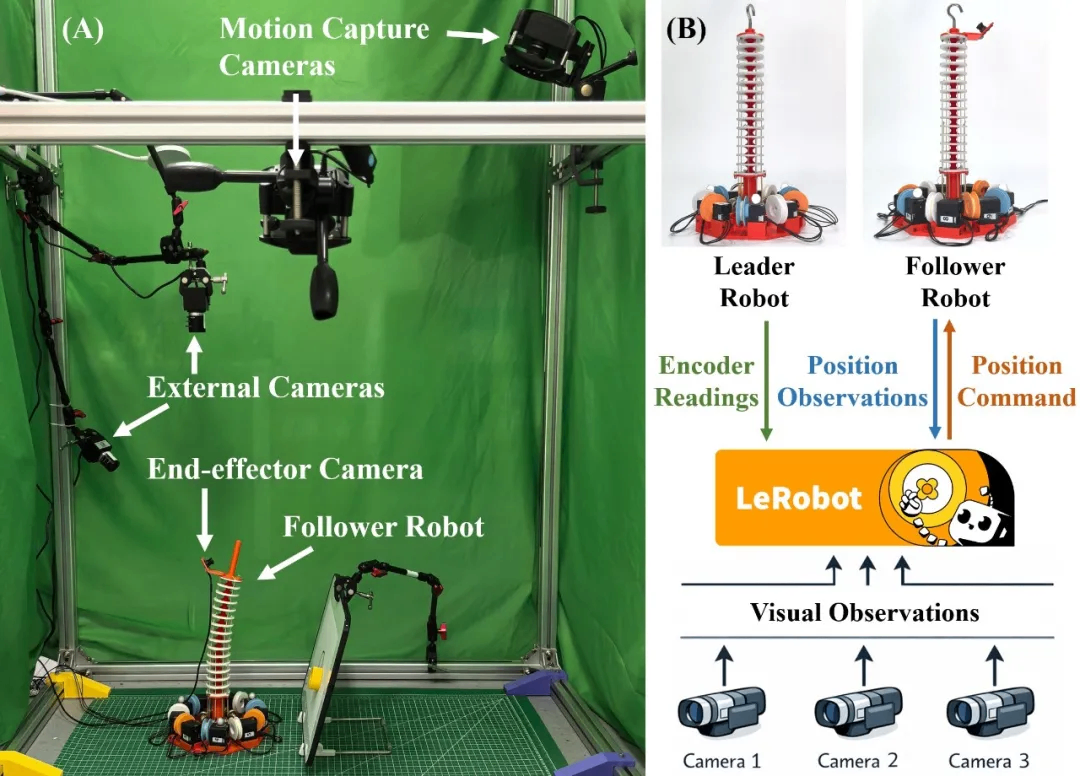
Figure 4. (A) Experimental setup for accuracy evaluation and imitation-learning-driven manipulation tasks. (B) Data flow for learning-driven manipulation tasks.
To assess the robot’s dexterity and the usability of the teleoperation framework, the operator successfully completed two manipulation tasks through the leader–follower interface: pick-and-place and object retrieval in a confined space. The average completion times over five trials were 25.0 s and 36.8 s, respectively.
Imitation-Learning-Driven Autonomous Manipulation
After training ACT policies on demonstrations collected via isomorphic teleoperation, the researchers evaluated three autonomous tasks on the physical robot: object placement, switch toggling, and planar pushing. The success rates were 12/12, 10/12, and 10/12, respectively—at least 83% in each task—demonstrating the feasibility of imitation learning for continuum robots.
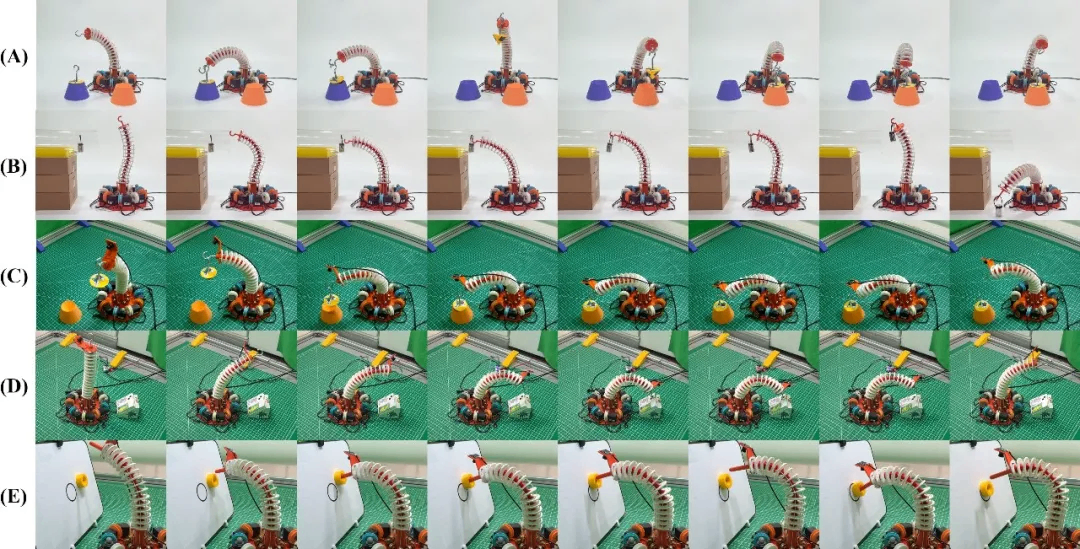
Figure 5. Teleoperation dexterity: (A) hooking and repositioning a weight; (B) retrieving an object from inside a tube. Autonomous manipulation: (C) object placement; (D) contact-based switch toggling; and (E) non-prehensile pushing of an object toward a target location.
Frequently Asked Questions
Q1: How can the three-dimensional position and motion trajectory of a continuum robot’s end effector be measured?
A1: An optical motion capture system can be used. In the CoLI continuum robot study, the NOKOV motion capture system (five Mars 1.3H cameras) tracked three reflective markers on each base and one on each end effector to measure the end-effector position of the leader and follower robots relative to their bases. It also recorded their motion trajectories, which were used to evaluate teleoperation position-tracking error and dynamic response.
Q2: What is the position-tracking error of isomorphic teleoperation for a continuum robot?
A2: The paper reports a mean positional tracking error of 8.2 mm across 127 configurations, equivalent to approximately 3.3% of the 243 mm arm length. In the experiment, the operator manually bent the leader to drive the follower. Once both robots reached a target configuration and remained stationary, the NOKOV motion capture system simultaneously recorded each end-effector position relative to its base, and the error was calculated from these positions.
Q3: How is the dynamic response of continuum robot teleoperation validated?
A3: The study recorded leader and follower trajectories to evaluate the follower’s settling-time latency. With the same NOKOV motion capture setup, the average settling-time latency across 12 trajectories was 158 ms, meeting the requirements for high-fidelity demonstration collection.
Q4: How does the CoLI platform achieve autonomous manipulation?
A4: CoLI uses actuator-level demonstrations collected through isomorphic teleoperation and integrates with the LeRobot framework to train ACT (Action Chunking with Transformers) policies. The paper reports success counts of 12/12, 10/12, and 10/12 for object placement, switch toggling, and planar pushing. The NOKOV motion capture system was used to validate the position-tracking accuracy and dynamic response of the teleoperation.
Paper Information
Paper title | CoLI: A Reproducible Platform for Continuum Robot Learning via Monolithic 3D Printing and Isomorphic Teleoperation |
Authors | Ziyuan Tang, Chenxi Xiao |
Affiliation | School of Information Science and Technology, ShanghaiTech University |
Conference | IROS 2026 |
Project page | |
GitHub repository | |
arXiv | |
DOI |
Corresponding Author
Chenxi Xiao is an Assistant Professor, researcher, and PhD supervisor at the School of Information Science and Technology, ShanghaiTech University, and heads the Robot Interaction and Manipulation Laboratory (RIM Lab). Research interests include robotics, embodied AI, teleoperation, haptic interaction, and reinforcement learning.
Related case study: IEEE RAL | A Continuum Climbing Robot with a Retractable Spring Backbone for Nuclear Facility Inspection


 Room820, China Minmetals Tower, Chaoyang Dist., Beijing
 info@nokov.cn
 + 86-10-64922321