A research team led by Prof. Ke Li from the School of Control Science and Engineering, Shandong University, proposed a unified framework for humanoid five-digit robotic grasping. The study combines demonstration-based trajectory generation with multi-agent reinforcement learning to improve coordinated grasping across different object categories.
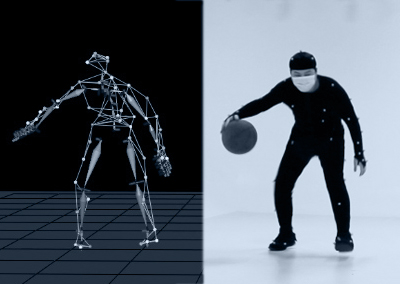
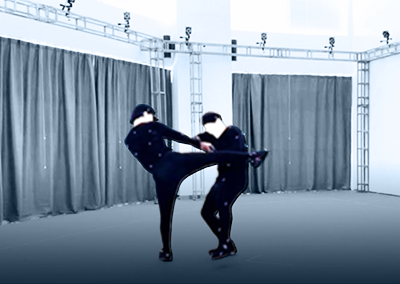
In the demonstration acquisition stage, NOKOV motion capture system recorded natural five-digit grasping movements of the human hand and provided 3D grasping trajectories and high-precision joint motion data. These data were processed into joint angle trajectories and used by DM-KMP to generate desired joint trajectories, providing prior knowledge for subsequent multi-agent reinforcement learning.
Key Information
Item | Content |
Research team | School of Control Science and Engineering, Shandong University |
Paper | Humanoid Five-Digit Robotic Grasping via Multi-Agent Reinforcement Learning With Potential-Guided Optimization and Weight Scheduling |
Research object | Humanoid five-digit robotic hand |
Research task | Coordinated dexterous grasping across diverse object categories |
Method | DM-KMP and PWS-MADDPG |
NOKOV role | Human grasping demonstration acquisition |
Measured object | Human five-digit grasping movements |
Output data | 3D grasping trajectories and finger joint motion data |
Data use | Generation of desired joint trajectories for DM-KMP and prior knowledge for reinforcement learning |
Reported result | PWS-MADDPG achieved an average grasping success rate of 85.48% across 11 object categories |
Research Background
Dexterous grasping with a humanoid five-digit robotic hand is difficult in unstructured environments because object shape, weight, material, and contact conditions can vary widely. Traditional demonstration-based learning often requires separate trajectories for different object types, which limits generalization. Single-agent reinforcement learning also faces challenges in coordinating the asynchronous motion of the thumb and fingers.
To address these issues, the research team proposed a unified learning framework that combines human demonstration trajectory generation with multi-agent reinforcement learning. The framework uses demonstration data to initialize grasping behavior and then applies reinforcement learning to improve multi-finger coordination.
The study introduces DM-KMP, a trajectory generation method that combines dynamic movement primitives with kernelized movement primitives. DM-KMP learns from limited human demonstrations and generates smoother desired joint trajectories for grasping tasks.
For policy learning, each finger of the humanoid hand is modeled as an independent agent under a multi-agent reinforcement learning framework. The paper further introduces potential-guided action refinement and weight-scheduled reward shaping to improve exploration, coordination, and convergence during training.
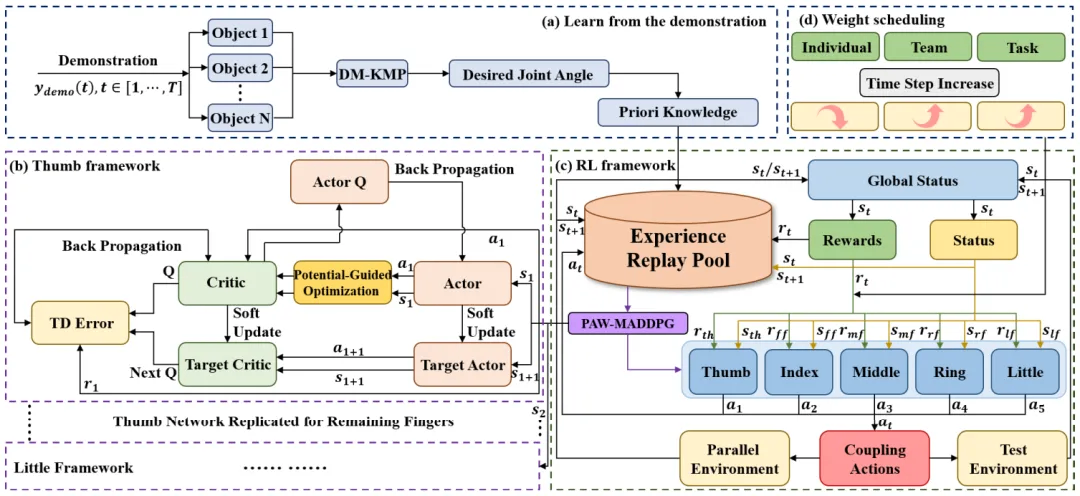
Figure 1. Framework of the proposed method. (a) Modules of learning from demonstration. (b) Modules of the thumb and fingers. (c) Modules of MARL. (d) Modules of weight scheduling.
These algorithmic methods and experimental results are contributions of the research team. NOKOV motion capture system was used in the human demonstration acquisition stage to provide motion data for the learning framework.
Role of NOKOV Motion Capture System in This Research
Item | Content |
Measured object | Human hand movements during natural five-digit grasping demonstrations |
Marker setup | Markers attached to finger joints |
Output data | 3D trajectories of grasping behavior |
Data use | Post-processed into joint angle trajectories and used by DM-KMP to learn and generate desired joint trajectories |
During human demonstration acquisition, the research team used NOKOV motion capture system to record natural five-digit grasping behavior. Markers attached to the finger joints enabled the collection of 3D grasping trajectories and high-precision joint motion data. After post-processing, the corresponding joint angle trajectories were used by DM-KMP to learn and generate desired joint trajectories, which then provided prior knowledge for subsequent multi-agent reinforcement learning.
Experimental Design and Results
The experimental validation included human demonstration acquisition, a Gazebo-based simulation environment, and a real-world robotic grasping platform. The real-world system included a KUKA LBR iiwa robotic arm, a Shadow dexterous hand, and an integrated perception-control grasping system.
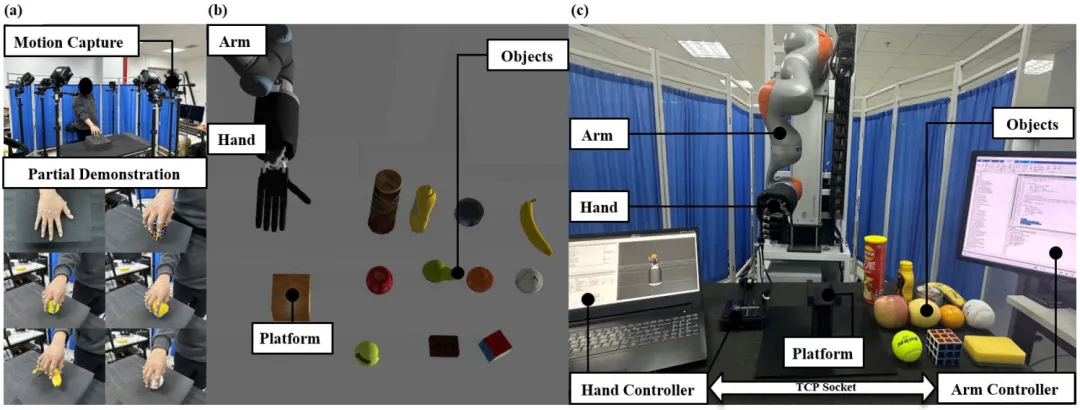
Figure 2. Experimental set-up. (a) Demonstration. (b) Simulation environment. (c) Real-world environment.
The paper reports that the robotic arms in simulation and real-world experiments were used only to position the dexterous hand at the grasp location and did not participate in policy training.
The figure below shows the five-digit joint angle trajectories of a human demonstrator grasping a foam brick after DM-KMP processing. The results show that after processing with the DM-KMP method, the joint trajectories become smoother and more continuous, which may serve as motion references for multi-agent reinforcement learning.
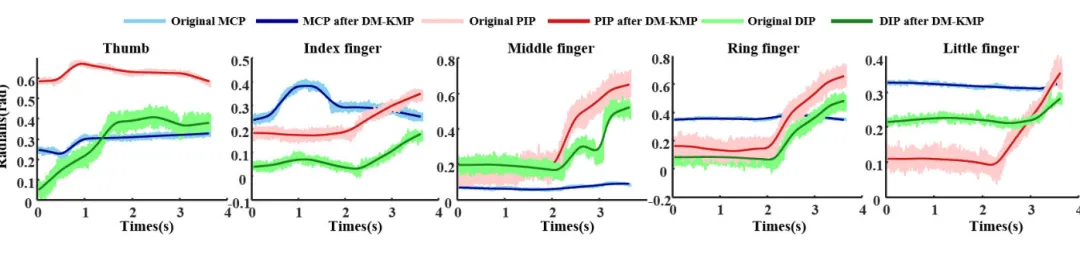
Figure 3. Humanoid five-digit joint angle trajectories during foam brick grasping by DM-KMP processing.
In the reported experiments, PWS-MADDPG achieved an average grasping success rate of 85.48% across 11 object categories. Compared with DDPG and MADDPG, the paper reports improvements of 40.31% and 20.05%, respectively. These results describe the performance of the research team's grasping control framework, not a direct performance claim about the motion capture system.
The study also included force-related grasping tests, including a custom force-sensing cup and deformable paper cups under different payload conditions. These tests were used to evaluate force regulation and stable grasping behavior under changing loads.
Research Significance
This case shows how human motion capture data can be used as structured demonstration information for humanoid dexterous grasping research. By recording natural human five-digit grasping movements, NOKOV motion capture system provided trajectory and joint motion data that supported demonstration-based policy initialization. The research then used multi-agent reinforcement learning to further optimize coordinated robotic hand control.
For robotics laboratories, this case provides a clear example of how motion capture can support the transition from human demonstration to robotic grasping policy learning while keeping data acquisition, algorithm design, and performance validation as distinct research stages.
Paper Information
Paper title: Humanoid Five-Digit Robotic Grasping via Multi-Agent Reinforcement Learning With Potential-Guided Optimization and Weight Scheduling
Citation: Wang, Jiashuai, et al. "Humanoid Five-Digit Robotic Grasping via Multi-Agent Reinforcement Learning With Potential-Guided Optimization and Weight Scheduling." IEEE Transactions on Automation Science and Engineering (2026).
Publication information: vol. 23, pp. 6299-6314, 2026
DOI: 10.1109/TASE.2026.3672621
FAQ
Q1:What did NOKOV motion capture system measure in this study?
A1:It measured natural five-digit grasping movements of the human hand during demonstration acquisition.
Q2:What data did the system provide?
A2:It provided 3D trajectories of grasping behavior and high-precision finger joint motion data, which were post-processed into joint angle trajectories.
Q3:How was the motion capture data used?
A3:The data were used by DM-KMP to learn and generate desired joint trajectories, providing prior knowledge for subsequent multi-agent reinforcement learning.
Q4:Can this demonstration-to-reinforcement-learning approach be applied to other dexterous manipulation tasks?
A4:The framework suggests a potentially extensible approach for other dexterous manipulation tasks, but its performance would depend on the task definition, demonstration data, reward design, and training setup.



 Room820, China Minmetals Tower, Chaoyang Dist., Beijing
 info@nokov.cn
 + 86-10-64922321