PIRNet for Real-Time 5-DoF Capsule Endoscopy Localization: How NOKOV motion capture provided optical reference data
A research team led by Prof. Shuxiang Guo at Southern University of Science and Technology proposed PIRNet, a physics-informed residual network for real-time 5-DoF magnetic localization in capsule endoscopy. In visible in vitro, ex vivo, and anti-interference experiments, the research team used NOKOV motion capture to obtain optical reference pose or trajectory data for annular magnets or capsule targets. These data support evaluation of PIRNet localization accuracy, robustness, and dynamic tracking behavior. The paper reports a mean position error of 0.69 +/- 0.29 mm, a mean orientation error of 0.70° +/- 0.37°, and less than 20% of the real-world calibration configurations required by data-driven baselines.
Case Overview
Item | Content |
Research team | Team led by Prof. Shuxiang Guo at Southern University of Science and Technology |
Paper | A Physics-Informed Residual Learning Method for Real-Time 5-DoF Magnetic Localization in Capsule Endoscopy |
Research object | Capsule endoscopy / mini-capsule magnetic localization |
Research task | Real-time 5-DoF magnetic localization and dynamic tracking evaluation |
Application field | Capsule endoscopy, magnetic medical robots, miniature in vivo robot localization |
Motion capture system | NOKOV motion capture |
Measured object | Annular magnet, mini-capsule target, or magnetic target depending on the experiment |
Output data | Optical reference pose or trajectory data |
Data use | Evaluation of PIRNet localization accuracy, robustness, dynamic tracking, and anti-interference compatibility |
Key results | Mean position error of 0.69 +/- 0.29 mm; mean orientation error of 0.70° +/- 0.37°; less than 20% of the calibration configurations required by data-driven baselines |
Research Background: why active capsule endoscopy needs reliable 5-DoF localization
Wireless capsule endoscopy is moving from passive imaging toward active robotic functions. For tasks such as targeted drug delivery, tissue biopsy, and minimally invasive procedures, the research team needs to know the capsule position and orientation in real time. Permanent-magnet tracking is attractive because it does not require internal power in the capsule, can propagate through biological media, and does not depend on line-of-sight measurement.
The localization problem remains difficult because ideal magnetic dipole models may not match real sensor measurements, while purely data-driven approaches can require large calibration datasets. PIRNet addresses this by learning residual corrections under physical constraints, aiming to reduce calibration burden while preserving localization consistency.
Research Method and Main Contribution: residual learning for the magnetic dipole model
PIRNet stands for Physics-Informed Residual Network. The framework uses a dual-branch architecture to separate local sensor distortion from systematic pose-dependent deviation, then computes a physically plausible correction to the idealized magnetic dipole model.
The paper compares two operating paradigms. PIRNet-LUT supports high-speed edge computing through lookup-table query and interpolation, while PIRNet-in-the-Loop uses end-to-end optimization to pursue higher localization accuracy. The two modes reflect different tradeoffs between computation and precision.
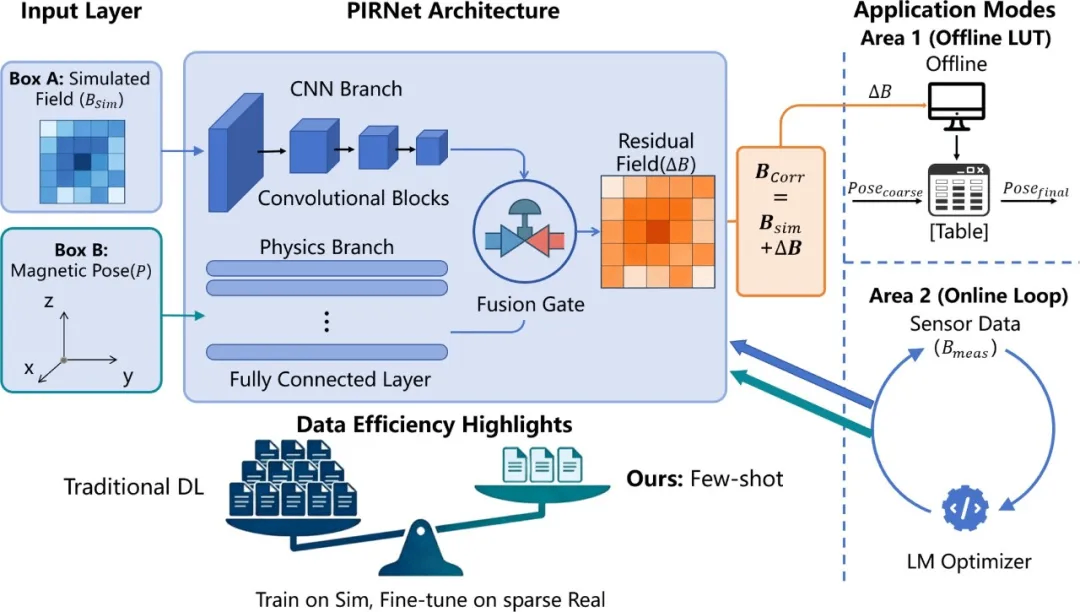
Architecture of the proposed PIRNet.
NOKOV's Role in This Study
Item | Content |
Measured object | Annular magnet, mini-capsule target, or magnetic target depending on the experiment |
Output data | Optical reference pose or trajectory data |
Data use | Evaluation of PIRNet localization accuracy, robustness, and dynamic tracking behavior |
In this study, the research team used NOKOV motion capture to obtain optical reference pose or trajectory data for annular magnets, mini-capsule targets, or magnetic targets. The data were used to evaluate PIRNet localization accuracy, robustness, and dynamic tracking behavior.
Why does magnetic localization need an optical reference?
Magnetic localization estimates the capsule position and orientation from magnetic sensor measurements. To quantify the localization error, the experimental setup requires an independent spatial reference. In visible in vitro and ex vivo conditions, NOKOV motion capture can provide optical reference pose or trajectory data for comparison with the magnetic localization output.
Experiment Design and Results: from core performance to dynamic tracking validation
Core performance and ablation experiments evaluate whether PIRNet can learn a physically plausible residual correction and how each architectural component contributes to localization accuracy. In these experiments, NOKOV motion capture provides 6-DoF optical reference pose data for comparison with PIRNet estimates.
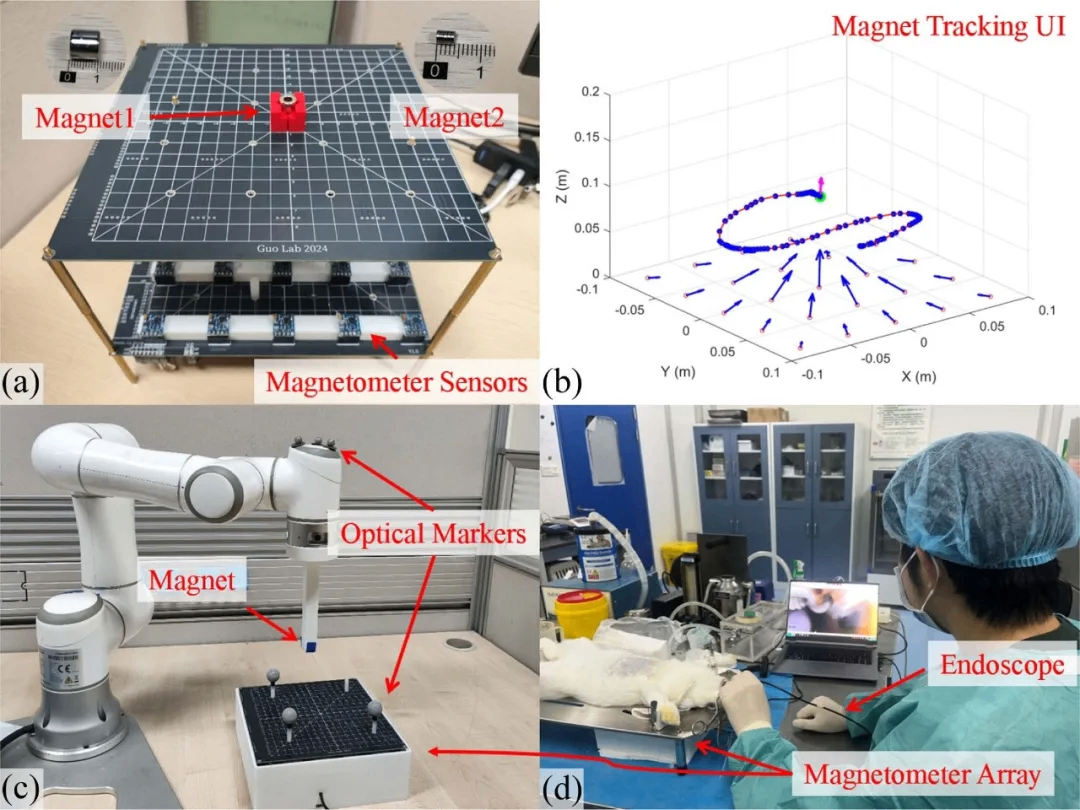
Experimental platforms, including the magnetometer sensor array, magnetic target, magnetic tracking interface, in vitro setup, and in vivo animal study overview.
Operational-paradigm experiments compare PIRNet-LUT and PIRNet-in-the-Loop across hardware platforms. The paper reports that PIRNet-in-the-Loop provides higher localization accuracy on GPU-enabled platforms, while PIRNet-LUT maintains real-time performance on CPU-constrained devices.
The data-efficiency experiments compared PIRNet with a purely data-driven ResNet under different amounts of real-world calibration data. The paper reports that PIRNet reached the accuracy of the fully trained data-driven baseline using less than one-fifth of the real-world calibration configurations.
Dynamic tracking validation includes an in vitro baseline test, ex vivo tissue tracking, and preliminary in vivo feasibility testing. The in vitro test uses a 10-mm standard annular magnet. The ex vivo test places two fresh porcine tissue blocks, each 30-40 mm thick, above the sensor array, with the magnetic target encapsulated in porcine hepatic tissue and driven by a robotic arm along predefined 3-D trajectories. In the New Zealand White rabbit study, optical tracking is structurally obstructed, so the evaluation uses endoscopic video and calibrated insertion-depth markers instead.
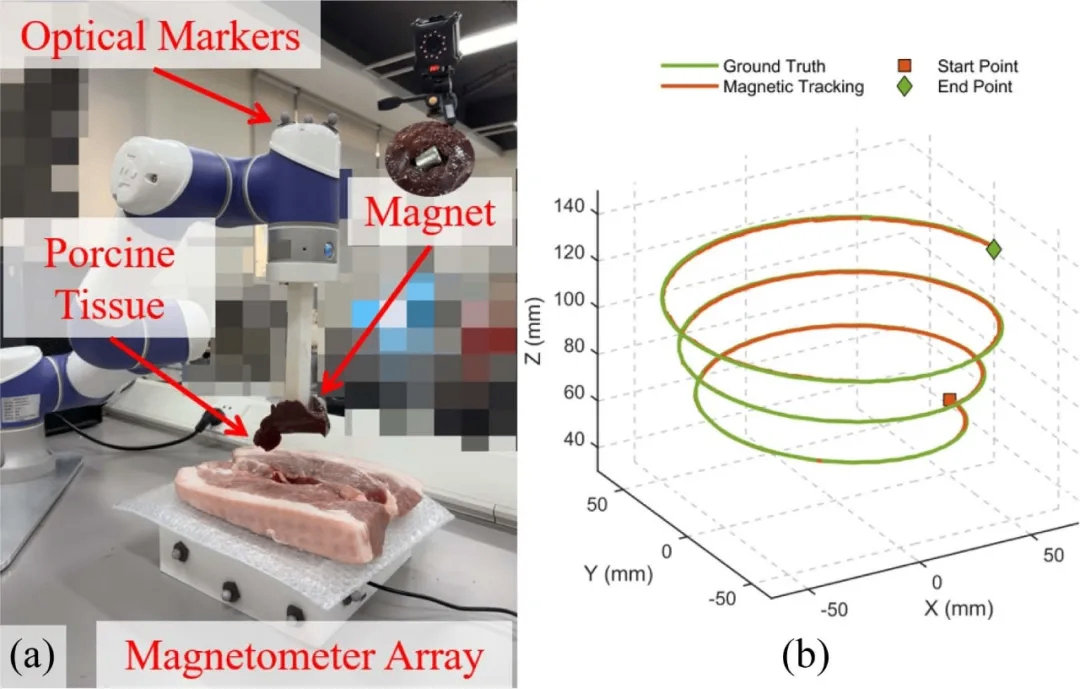
Quantitative ex vivo dynamic tracking performance through porcine tissue.
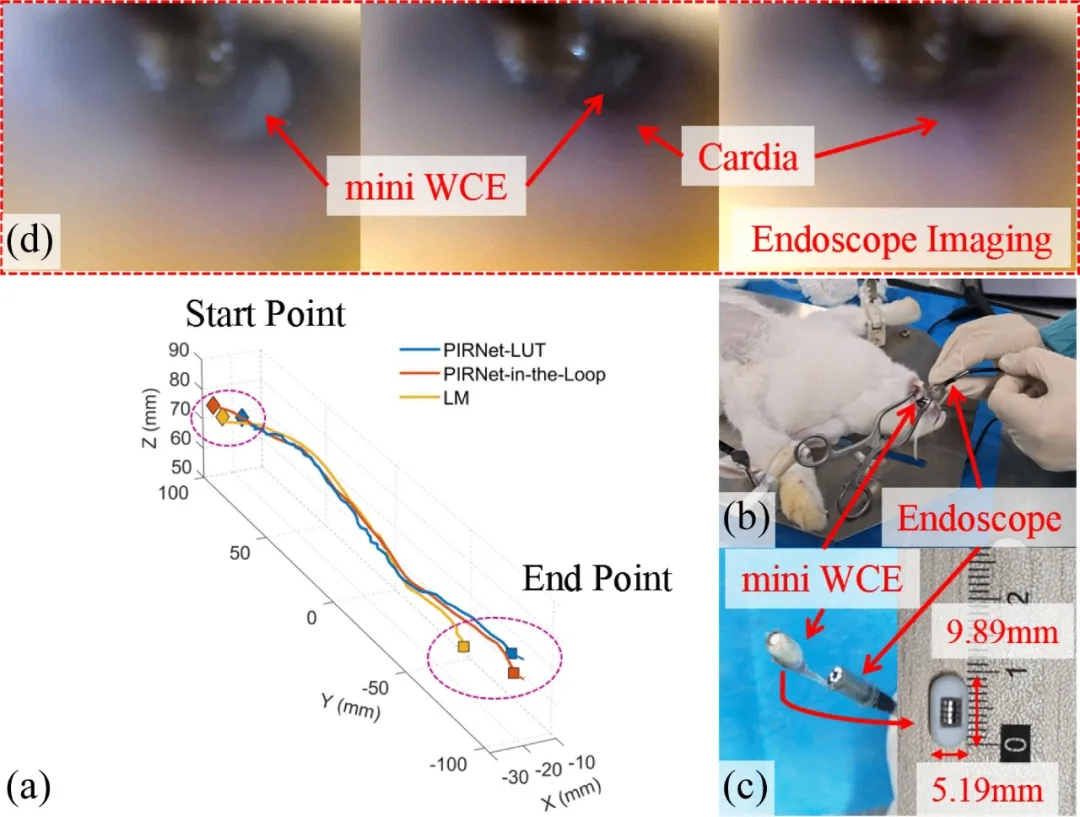
In vivo animal study results.
Anti-Interference Compatibility
This experiment evaluates PIRNet’s ability to function as a modular observation engine when integrated into a downstream filtering pipeline. A surgical instrument made of soft-magnetic material was introduced into the tracking volume, and the downstream filtering architecture comprised a linear blind source separation module and an adaptive Kalman filter. The NOKOV motion capture system provided an independent optical reference under the interference condition for performance evaluation.
The results show that the integrated system using PIRNet-in-the-Loop maintains bounded residuals during the interference interval, allowing the downstream filter to isolate induced distortions and supporting compatibility with industrial filtering architectures.
For in vitro and ex vivo tests, the NOKOV motion capture system provided baseline 6-DoF pose data with a certified accuracy of ±0.15 mm at 380 frames per second, serving as an optical reference for evaluating PIRNet localization accuracy and robustness. In the in vivo animal study, optical tracking is structurally obstructed; evaluation instead relies on endoscopic video and calibrated insertion-depth markers.
Demonstrated Tasks and Application Status
PIRNet is positioned as a localization method for active capsule endoscopy research. The in vivo animal study is described as preliminary feasibility testing, not as clinical deployment.
In the reported experiments, NOKOV motion capture provided an independent optical reference under visible experimental conditions, allowing the research team to compare magnetic localization output with reference pose or trajectory data.
Research Significance
This work shows how a physics-informed residual learning strategy can help reduce real-world calibration requirements in magnetic localization. For capsule endoscopy and other miniature in vivo robotic systems, this may lower experimental calibration burden while maintaining localization accuracy.
For NOKOV motion capture, the evidence-grounded role is not that it created the PIRNet method or improved the algorithm by itself. The supported relationship is that the research team used NOKOV motion capture to obtain optical reference pose or trajectory data for evaluating PIRNet output.
Paper Information
Title: A Physics-Informed Residual Learning Method for Real-Time 5-DoF Magnetic Localization in Capsule Endoscopy
Citation: M. Shen et al., "A Physics-Informed Residual Learning Method for Real-Time 5-DoF Magnetic Localization in Capsule Endoscopy," in IEEE Transactions on Industrial Informatics, doi: 10.1109/TII.2026.3688686.
READ the PAPER: https://www.webofscience.com/wos/woscc/full-record/WOS:001767458000001
Author Biographies
Miaozhang Shen is an M.S. student in electronic information at Southern University of Science and Technology and is affiliated with the Department of Electronic and Electrical Engineering and the Advanced Institute for Ocean Research. His research interests include magnetic medical robot systems.
Shuxiang Guo (Corresponding Author) is a Chair Professor with the Department of Electronic and Electrical Engineering, Southern University of Science and Technology, and a Fellow of the Engineering Academy of Japan. His research interests include medical robot systems, microcatheter systems, and biomimetic underwater robots.
Zixu Wang (Corresponding Author) is a Postdoctoral Researcher with Southern University of Science and Technology. His research interests include medical robot systems for minimally invasive surgery and magnetic-driven flexible robots.
Yuyue Yang is pursuing the M.S. degree in integrated circuit engineering with South China Normal University. His research interests include computational imaging and optical design.
Chunying Li is a Research Assistant Professor with the Advanced Institute for Ocean Research, Southern University of Science and Technology. His research interests include bionic underwater robots, control systems, multisensor information fusion, and multirobot collaboration.
Mingchao Ding is a Professor, Chief Physician, and Vice President with Aerospace Center Hospital, Beijing. His research interests include endovascular and emergency interventional treatment of ischemic, bleeding, and thrombotic vascular diseases.
Bing Wang is the Director of the Interventional Vascular Department, Chief Physician, and Master’s Supervisor with Aerospace Center Hospital, Beijing. His expertise includes interventional treatment of peripheral vascular diseases, deep vein thrombosis, pulmonary embolism, ischemic vascular diseases, and minimally invasive treatment of varicose veins.
FAQ
Q1: What did NOKOV motion capture measure in this study?
A1: It measured optical reference pose or trajectory data of annular magnet or capsule targets in visible in vitro and ex vivo experimental conditions.
Q2: How were the NOKOV motion capture data used?
A2: They were used as reference data for evaluating PIRNet localization accuracy, robustness, and dynamic tracking behavior.
Related Reading
How Concentric Tube Robots Keep Their Whole Body on the Path丨TASE 2025丨 NOKOV Motion Capture Case



 Room820, China Minmetals Tower, Chaoyang Dist., Beijing
 info@nokov.cn
 + 86-10-64922321