Case Summary
Mingguo Zhao’s research team at Tsinghua University developed a unified vision-driven reinforcement learning controller that enables humanoid robots to seamlessly search for, chase, and kick a ball in multiple directions using only onboard vision.
A team led by Mingguo Zhao from the Department of Automation at Tsinghua University published the paper “Learning vision-driven reactive soccer skills for humanoid robots” in the leading robotics journal Science Robotics.
The paper presents a unified reinforcement learning-based controller that directly couples visual perception with locomotion control. Trained entirely in simulation and deployed zero-shot on a physical humanoid robot, the controller uses only onboard vision to seamlessly perform ball searching, chasing, and multidirectional kicking.
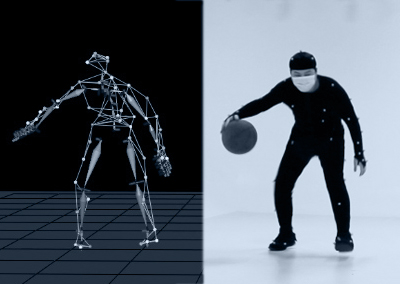
NOKOV motion capture system provided human kicking motion data and ground-truth positions of the robot and ball, respectively supporting construction of the reference motion dataset and modeling of the virtual perception system.
Citation
Yushi Wang et al., Learning vision-driven reactive soccer skills for humanoid robots. Sci. Robot. 11, eaed1152 (2026). DOI: 10.1126/scirobotics.aed1152
Read the Paper Here: Web of Science
Key Project Information
Item | Details |
Research Institution | Tsinghua University, Department of Automation |
Publication | Science Robotics |
Robot | Booster T1 humanoid robot |
Task | Vision-driven reactive soccer |
Learning Methods | Reinforcement learning, AMP, encoder-decoder architecture |
Visual Input | Onboard camera |
NOKOV Motion Capture System Application | Human kicking motion capture Ground-truth tracking of the robot and ball |
Real-World Performance | 80–90% kicking success in frontfield positions |
Tested Environments | Real world Environments: Grass, slabstone, soil, asphalt, rubber |
Research Background: Why Do Humanoid Robots Need Vision-Driven Reactive Soccer Control?
Humanoid soccer requires robots to tightly couple agile locomotion with unreliable onboard visual perception. Conventional modular pipelines that separate perception, planning, and control struggle to produce agile reactions in dynamic environments. Existing end-to-end reinforcement learning approaches either rely on privileged state information provided by motion capture systems, limiting deployment beyond laboratory environments, or depend on computationally intensive scene modeling and suffer performance degradation during sim-to-real transfer. Consequently, a vision-driven reactive humanoid soccer controller that can operate robustly in real-world environments remains an open challenge.
How Do Humanoid Robots Learn to Play Soccer Through Reinforcement Learning?
The study formulates humanoid soccer as a “perception-constrained control problem”: rather than treating perception as a preprocessing module that provides inputs to the controller, realistic perceptual uncertainty is modeled as an integral component of the learning process. A single reinforcement learning policy is trained in simulation to receive visual detections and robot proprioception and output target joint positions, allowing ball searching, approaching, gait adjustment, and kicking to be executed continuously within one control framework. After training, the policy is deployed zero-shot on a Booster T1 humanoid robot (approximately 1.2 m tall and 30 kg), operating only with onboard cameras and onboard computation.
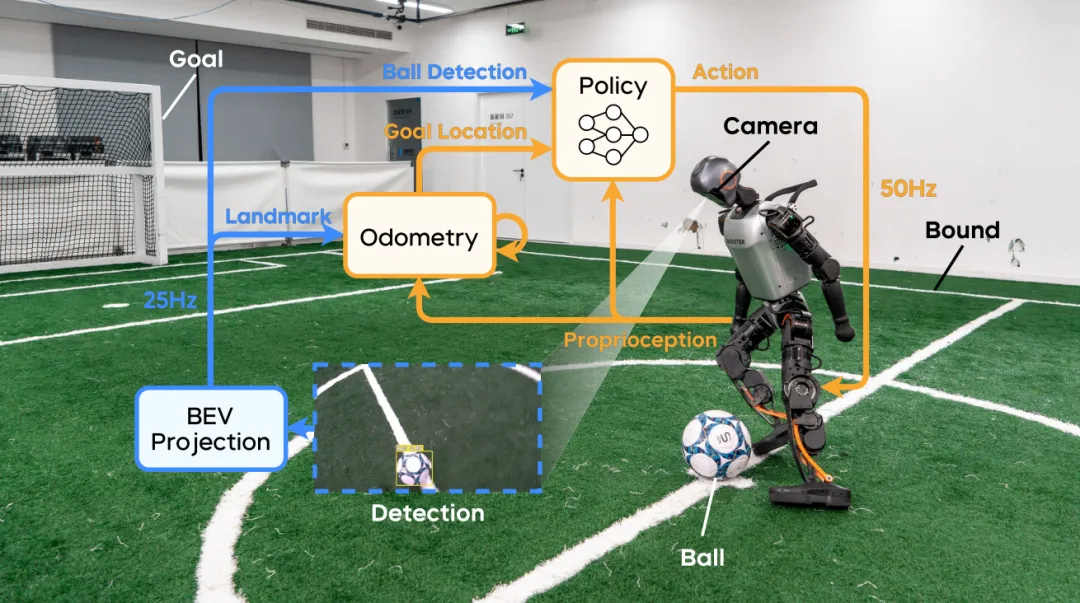
System overview. The real-world robot is equipped with an onboard camera for visual perception. Image detections are projected into the bird’s-eye-view (BEV) space. Ball detections are provided directly to the policy, and field landmarks are processed by an odometry module to infer the goal location from long-term information. The perception pipeline is designed to efficiently extract and represent visual features for the reinforcement learning (RL) policy.
Innovation 1: How Does End-to-End Perception-Action Coupling Work?
Unlike conventional modular pipelines that separate perception, planning, and control, the proposed policy directly couples visual perception with locomotion control. Perception is no longer treated as a preprocessing module that simply provides inputs to the controller; instead, perceptual uncertainty becomes an integral part of the learning process, enabling the policy to continuously adapt its motion in a closed loop.
Innovation 2: How Are Human Kicking Motions Used to Train the Robot?
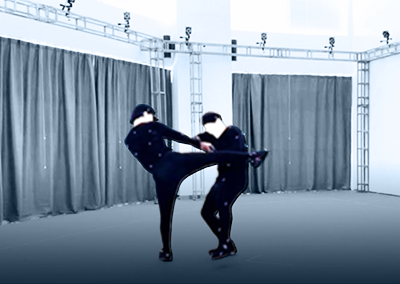
To learn humanlike kicking behavior, the study constructed a reference motion dataset using human arch-based kicking motions and public walking data. NOKOV motion capture system recorded 30 s of human arch-based kicking motions, while 76.28 s of omnidirectional walking data were selected from the public ACCAD motion capture dataset. The dataset was used to train the AMP discriminator, guiding the policy toward natural motion patterns while optimizing task performance. By integrating AMP with the perception pipeline, the study further extends AMP toward real-world control in dynamic visual scenarios.
Innovation 3: How Does the System Bridge the Sim-to-Real Gap?
Real-world onboard vision is noisy, delayed, and subject to detection failures. The study therefore explicitly modeled these perceptual imperfections in simulation using parameters derived from real data: a rule-based ball-tracking program controlled the robot while a human operator moved the ball across the field, collecting approximately 1 hour of observation data. NOKOV motion capture system recorded the ground-truth positions of the robot and ball, which were compared with visual detections for quantitative modeling. On this basis, the policy network uses an encoder-decoder architecture: the encoder compresses the preceding 50 observation frames (about 1 s of history) into a 64-dimensional latent representation, while the decoder reconstructs privileged information unavailable at deployment, such as the ground-truth ball position. This forces the policy to recover reliable state information from noisy and incomplete observations.
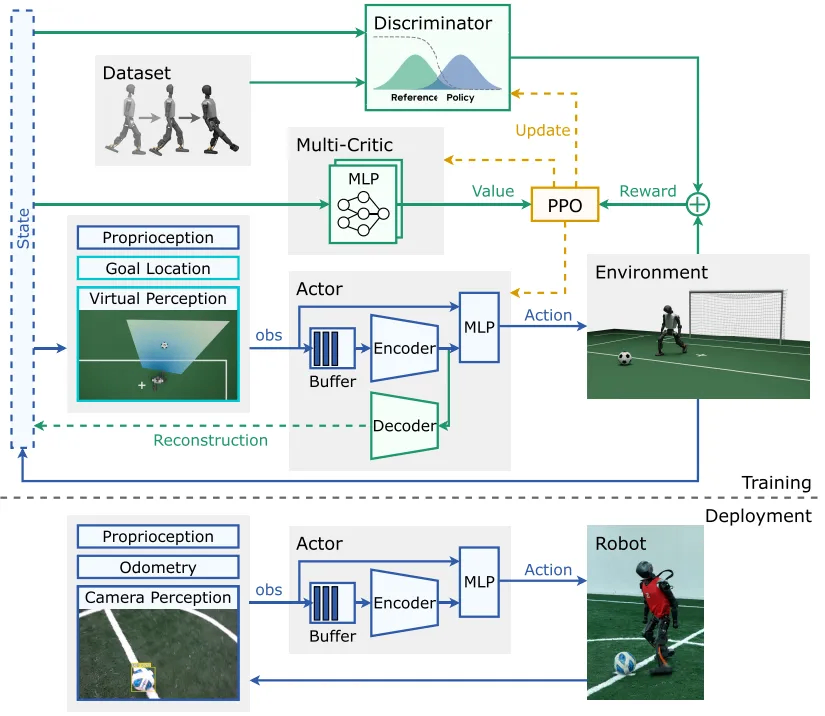
The proposed learning framework. The actor receives partial observations and reconstructs the full state from historical data using an encoder-decoder architecture. The policy is trained with PPO, using rewards from both the environment and a discriminator encoding motion priors, with multiple critics providing value estimates. The policy is trained in simulation with only the modules highlighted in blue deployed on hardware.
Experimental Validation:How Well Does the Vision-Driven Humanoid Soccer Controller Perform in Real-World Tests?
Performance Across Diverse Scenarios and Real Competitions
The controller was deployed zero-shot across grass, slabstone, soil, asphalt, rubber, and diverse visual conditions, maintaining reliable ball tracking and locomotion in all scenarios. The controller was also adopted as a module by Tsinghua Hephaestus team in the RoboCup 2025 Adult-Size Humanoid League and the 2025 World Humanoid Robot Games, where the team won championships.
Kicking Success Rates
Following the adult-size specifications of the RoboCup Humanoid League, the study evaluated kicking success rates from multiple predefined field positions. Hardware experiments achieved approximately 80-90% success in frontfield positions, comparable to simulation, with no falls recorded across all trials.
Perception-Action Coordination
To evaluate perception-action coupling, the policy actively adjusts the robot’s head and torso orientations to keep the ball within the camera’s field of view. The policy substantially reduces ball-position estimation error by 46%.
Gait Behavior Analysis
To analyze the diversity and agility of the learned motion patterns, the study showed that a single policy can smoothly transition among walking, turning, left-foot kicking, and right-foot kicking behaviors, while demonstrating greater agility than the rule-based baseline.
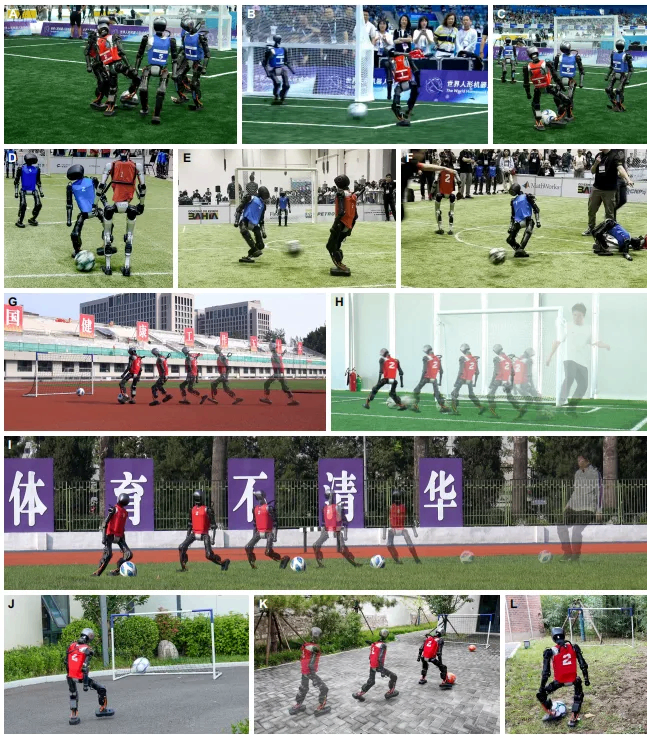
Performance of the controller in various scenarios. (A to C) Real match performance at the World Humanoid Robot Games. (D to F) Real match performance at RoboCup. (G to I) Reactive responses and real-time adaptation to the ball. (J to L) Robust behavior across varying terrain and visually diverse environments.
How Was NOKOV Motion Capture Used in the Study?
NOKOV motion capture system supported two data-collection tasks in this research:
1. Human motion capture: recording 30s of human kicking motions to construct the reference motion dataset used by the AMP discriminator.
2. Ground-truth measurement: tracking the positions of the robot and soccer ball and comparing them with visual detections to quantitatively model the virtual perception system.
These two types of motion capture data supported the simulation-based training and sim-to-real transfer of the humanoid soccer policy. NOKOV motion capture system provided both human motion references for learning natural kicking behaviors and high-precision ground-truth measurements for modeling real-world visual perception.
Corresponding Author
Mingguo Zhao, Researcher at the Department of Automation, Tsinghua University; Director of the Robot Control Laboratory; Director of the Brain-Inspired Robotics Interdisciplinary Center at the Center for Unmanned Systems; and Chief Scientist at Booster Robotics. His research focuses on building artificial general intelligence research platforms by integrating “brain-inspired chips” and “brain-inspired computing,” as well as robot control based on brain-inspired computing.
FAQ
Q1:What role did the NOKOV motion capture system play in this humanoid soccer study?
A1:NOKOV motion capture system was used for two main data-collection tasks: capturing human kicking motions to construct the AMP reference motion dataset, and measuring the ground-truth positions of the robot and soccer ball for virtual perception system modeling.
Q2:Why were human motion data needed for humanoid soccer?
A2:Human kicking motions were used to construct a reference motion dataset for training the AMP discriminator, helping the reinforcement learning policy learn natural motion patterns while performing the soccer task.
Q3:How did the researchers address visual perception noise?
A3:The researchers used ground-truth robot and ball positions measured by the NOKOV motion capture system and compared them with visual detections. These data were used to quantitatively model perception noise, delays, and detection failures in simulation.
Q4:How did the humanoid robot perform in real-world tests?
The controller achieved approximately 80–90% kicking success in frontfield positions and completed the hardware experiments without falls. It was also tested across different terrains and visual conditions and used in real humanoid soccer competitions.
According to related reports from Tsinghua University, the controller also supported the Tsinghua Hephaestus team in winning the adult-size humanoid soccer championships at RoboCup in 2025 and 2026, as well as defending its title at the 2026 World Humanoid Robot Games.



 Room820, China Minmetals Tower, Chaoyang Dist., Beijing
 info@nokov.cn
 + 86-10-64922321