Abstract
A research team led by Siyuan Huang and Tengyu Liu at the Beijing Institute for General Artificial Intelligence (BIGAI) presented Towards Human-level Dexterous Teleoperation at the Conference on Robot Learning (CoRL 2026). The paper introduces TeleDexter, a hand-object co-tracking controller that enables dexterous robot hands to perform complex in-hand manipulation and long-horizon tool-use tasks through teleoperation.
In this research, NOKOV motion capture was used to collect offline human hand-object interaction demonstrations and provide real-time tracking of the operator's wrist, fingertips, and manipulated object. The captured motion data supports reference motion construction for reinforcement learning, online dexterous teleoperation, and the subsequent training of autonomous robot manipulation policies.
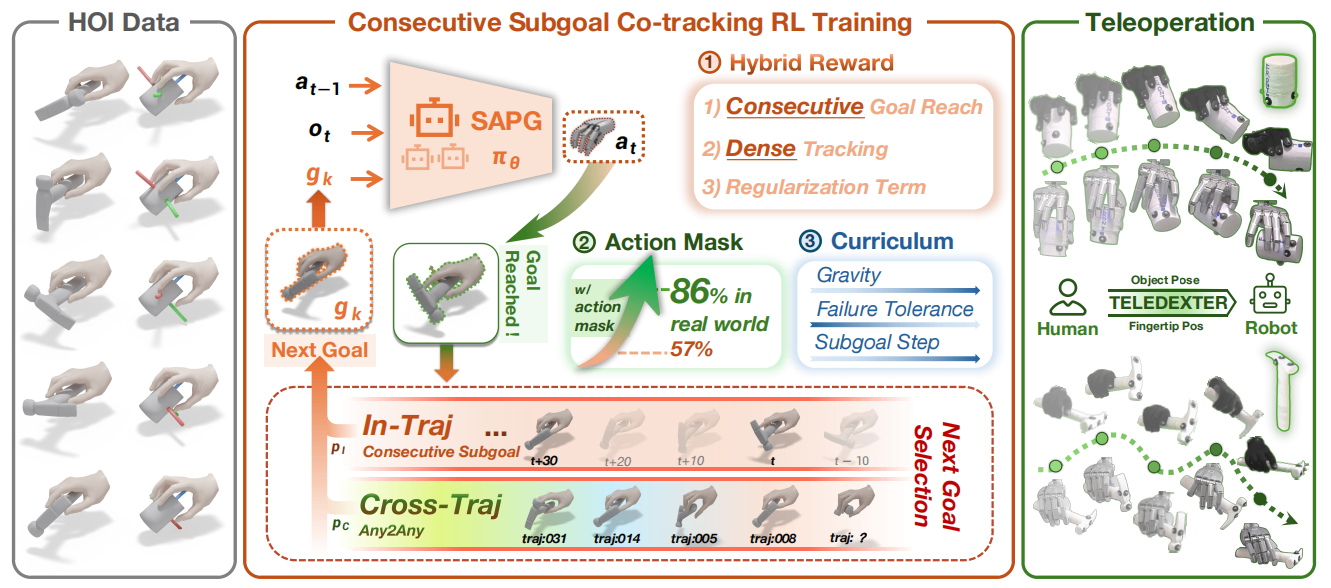
Overview of the TELEDEXTER Method
Research Overview
Item | Details |
Research Institution | Beijing Institute for General Artificial Intelligence (BIGAI) |
Conference | CoRL 2026 |
Paper Title | Towards Human-level Dexterous Teleoperation |
Research Topic | Dexterous robot teleoperation and hand-object co-tracking |
Motion Capture System | NOKOV Optical Motion Capture System |
Offline Tracking | Human hand and object interaction motions |
Real-Time Tracking | Wrist pose, fingertip positions, and object 6-DoF pose |
Robot Platform | Franka FR3 robotic arm |
Dexterous Hands | SharpaWave (22-DoF) and LeapHand (16-DoF) |
Teleoperation Rate | 30 Hz |
Average Teleoperation Success Rate | 75.2% |
Average Task Progress | 87.1% |
Research Background: Why Is Hand-Object Tracking Important for Dexterous Teleoperation?
Human hands can continuously translate and reorient objects within a single hand, switch grasp configurations, and perform complex finger-gaiting motions. Enabling robot dexterous hands to achieve similar capabilities through teleoperation remains challenging.
Conventional kinematic retargeting methods directly map human hand movements to robot joint configurations. However, they often overlook contact forces, friction, and object inertia. As a result, objects may slip or fall during high-acceleration movements, non-grasping interactions, and continuous finger repositioning.
Learning-based motion priors provide another approach, but existing methods often rely on simulated grasp-transition data and may struggle with physically feasible contact execution.
To address these challenges, the research team proposed TeleDexter, a hand-object co-tracking framework that allows operators to specify both fingertip positions and object poses. A reinforcement learning controller then determines how the robot hand should execute the required contact transitions.
Method Overview: TeleDexter Hand-Object Co-Tracking and Reinforcement Learning
TeleDexter separates operator intent from low-level contact execution. Instead of directly copying human hand joint movements, the operator specifies synchronized geometric targets for the fingertips and manipulated object. A controller trained through reinforcement learning determines the robot hand movements needed to achieve these targets.
The framework introduces three key designs:
1. Consecutive Co-Tracking Subgoals
Human reference motions are converted into a sequence of synchronized fingertip and object-pose subgoals. The reinforcement learning policy learns to reach these subgoals using a hybrid reward that combines sparse subgoal objectives with dense tracking rewards, rather than imitating every motion frame.
2. Geometry-Aware Reference Motion Construction
A geometry-aware retargeting pipeline transforms unstructured human hand-object demonstrations into physically plausible reference motions. A two-stage optimization process incorporates object meshes to improve contact-surface alignment and penalize object penetration and finger self-collision.
3. Sim-to-Real Robustness
Random action masking is introduced as an action-space regularization strategy, together with systematic domain randomization. These techniques enable the learned controller to transfer from simulation to real robotic hands without additional real-world policy training.
NOKOV motion capture provides the human hand and object motion data required for reference motion construction and real-time hand-object co-tracking.
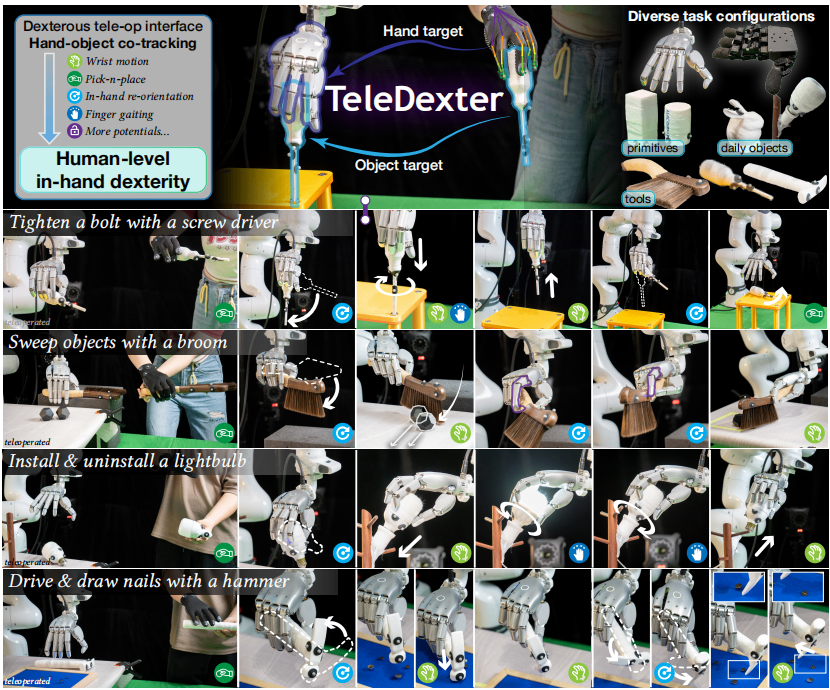
Experimental Validation
Experimental Setup: Motion Capture for Dexterous Robot Teleoperation
The experimental platform consists of a Franka FR3 robotic arm equipped with two dexterous hands: the five-finger SharpaWave hand with 22 degrees of freedom and the four-finger LeapHand with 16 degrees of freedom.
The research team used the NOKOV optical motion capture system to track the operator's hand and manipulated object. All teleoperation methods, including the baselines, shared the same motion capture interface and operated at 30 Hz.
The evaluated teleoperation baselines included:
DexRT: Kinematic retargeting.
GeoRT: Learning-based neural retargeting.
DexGen: Generative motion prior.
SimToolReal was also included as an object-centric, non-teleoperation reference method.
Offline Motion Capture: Collecting Human Hand-Object Interaction Demonstrations
For offline data collection, the operator wore a dense marker glove with reflective markers placed on the wrist, palm, and finger joints.
Using NOKOV motion capture, the team recorded human hand-object interaction trajectories at 30 Hz. For each object, 150 trajectories were collected, with each trajectory lasting 20 seconds.
The captured data included 3D hand-joint positions, joint orientations, wrist pose, and object pose. These recordings were processed through the geometry-aware retargeting pipeline to generate reference motions for reinforcement learning.
By combining optical motion capture with object-mesh-based geometric optimization, the team constructed synchronized fingertip and object-pose targets for controller training.
Real-Time Motion Tracking: Wrist, Fingertip, and Object Pose Tracking
During online teleoperation, the operator wore a compact glove equipped with reflective markers only on the wrist and fingertips.
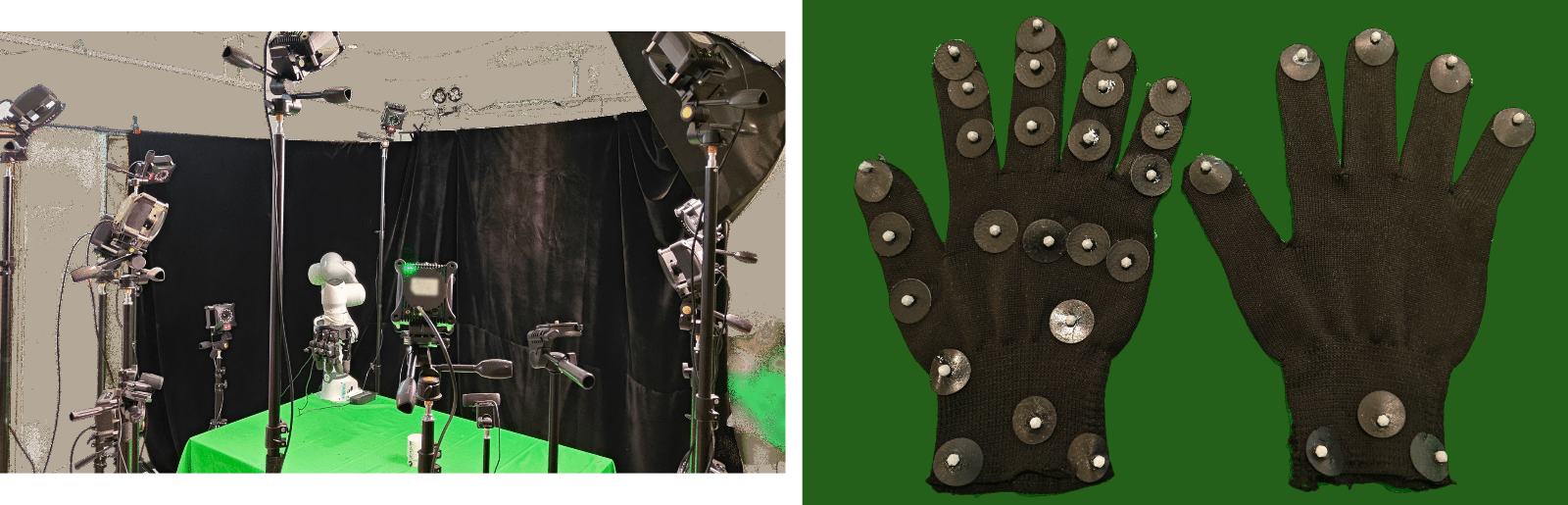
Hand–object motion capture setup.
(a) NOKOV optical motion capture system setup. (b) Two marker-glove configurations: the left glove is used for offline reference motion collection, with dense reflective markers placed on the wrist, palm, and all finger joints; the right glove is used for real-time teleoperation, with markers placed only on the wrist and fingertips.
The NOKOV motion capture system provided real-time tracking data for three key elements:
Wrist 6-DoF pose: Used for robotic arm inverse kinematics control.
Fingertip 3D positions: Used as targets for dexterous hand co-tracking.
Object 6-DoF pose: Used to define the target object motion.
During contact initialization, kinematic retargeting was used to establish the initial grasp. Once stable contact was achieved, control switched to the TeleDexter co-tracking controller.
This setup enabled synchronized tracking of human hand movements and object motion, providing the geometric targets required for real-time dexterous teleoperation.
Dexterous Teleoperation Performance Evaluation
The team evaluated TeleDexter on seven tasks using the SharpaWave hand: three in-hand object reorientation tasks involving a cylinder, cuboid, and bunny-shaped object, and four long-horizon tool-use tasks involving hammering, brush sweeping, screwdriver operation, and bulb replacement.
TeleDexter achieved an average task success rate of 75.2% and an average task progress of 87.1%.
For comparison, the DexRT kinematic retargeting baseline achieved an average success rate of 5.7%, while GeoRT and DexGen both achieved 0% average success rates.
The team also evaluated cross-hand generalization using the LeapHand. With the same human reference motion data, the framework achieved success rates of 60.0% and 73.3% on the two in-hand reorientation tasks, demonstrating its ability to adapt reference motions across different robot hand morphologies without collecting new human demonstrations.
From Teleoperation to Autonomous Manipulation
To investigate whether teleoperation demonstrations could support autonomous robot learning, the research team used demonstrations collected through the NOKOV motion capture interface to train a Diffusion Policy based on RGB observations from third-person and wrist-mounted cameras.
The team collected 50 demonstrations per task and evaluated the learned autonomous policy on three simplified tasks derived from the original tool-use tasks:
Autonomous Task | Success Rate |
Bulb Installation | 46.7% |
Hammer Driving | 73.3% |
Forward Brush Sweeping | 40.0% |
These results demonstrate that human hand-object interaction demonstrations collected through motion capture can be further used to train autonomous robot manipulation policies, extending the value of teleoperation data beyond real-time human control.
Ablation Study
Simulation experiments showed that consecutive subgoal tracking substantially outperformed frame-by-frame tracking.
Real-robot ablation experiments further demonstrated the importance of random action masking for sim-to-real transfer. When random action masking was removed, the success rate on the ScrewdriverUse task dropped from 73.3% to 0%.
These findings highlight the importance of the proposed learning and regularization strategies in achieving robust real-world dexterous manipulation.
Frequently Asked Questions (FAQ)
Q1: How can human fingertip movements and object poses be tracked simultaneously for dexterous robot teleoperation?
A1:Optical motion capture can track reflective markers attached to the operator's wrist and fingertips, as well as markers on the manipulated object. In the TeleDexter research, the NOKOV motion capture system provided real-time wrist pose, fingertip positions, and object 6-DoF pose, enabling synchronized hand-object tracking for robot control.
Q2: What motion data can an optical motion capture system collect for dexterous hand research?
A2:An optical motion capture system can capture 3D hand-joint positions, wrist pose, fingertip positions, and the 6-DoF pose of manipulated objects, depending on the marker configuration. In this study, NOKOV motion capture supported both dense offline hand-object demonstration collection and compact real-time tracking during teleoperation.
Q3: How can human hand-object demonstrations be collected for robot reinforcement learning?
A3:Researchers can use optical motion capture to record human hand-object interaction trajectories and then process the captured data through motion retargeting and geometric optimization. In TeleDexter, the research team used NOKOV motion capture to collect human demonstrations and construct physically plausible reference motions for reinforcement learning.
Q4: What is the difference between an optical motion capture system and a sensor-based data glove?
A4: A sensor-based data glove typically measures finger bending or joint angles through embedded sensors. An optical motion capture system tracks the 3D positions of external reflective markers using infrared cameras. In the TeleDexter study, the gloves served as marker carriers rather than electronic finger-sensing devices. NOKOV motion capture tracked the hand and manipulated object externally, enabling synchronized 3D motion measurement.
Q5: Can motion capture demonstrations be used to train autonomous robot manipulation policies?
A5:Yes. Human demonstrations collected through motion capture can be processed and used to train imitation learning or reinforcement learning policies. In TeleDexter, demonstrations collected through the NOKOV motion capture interface were used to train a Diffusion Policy for autonomous bulb installation, hammer driving, and brush sweeping.
Paper Information
Item | Details |
Paper Title | Towards Human-level Dexterous Teleoperation |
Framework | TeleDexter |
Authors | Puhao Li(Co-first author), Zeyuan Chen(Co-first author), Yingying Wu(Co-first author), Pengkun Wei, Yuyang Li, Tianyu Wang, Jiaxiao Shi, Mingrui Yu, Baoxiong Jia, Song-Chun Zhu, Tengyu Liu(Corresponding author), and Siyuan Huang(Corresponding author) |
Research Team | BIGAI Dexterity Team |
Publication | Conference on Robot Learning (CoRL 2026) |
Research Areas | Dexterous Manipulation, Robot Teleoperation, Hand-Object Interaction, Reinforcement Learning |
Original Paper: Towards Human-level Dexterous Teleoperation
Project Website: https://bigai-dex.github.io/blog/teledexter/


 Room820, China Minmetals Tower, Chaoyang Dist., Beijing
 info@nokov.cn
 + 86-10-64922321